By Sagi Shaier · 14 November 2026 · 6 min read
Emergent abilities in LLMs
Why a task can sit near chance for small models and jump at larger sizes, how prompting with and without examples works, and why part of the jump may come from how the task is scored.
An emergent ability in a large language model (LLM) is a skill that is weak or absent in smaller models and becomes usable in larger ones, without being trained as a separate objective. Following plain-language instructions, multi-step arithmetic and turning a request into valid JSON are common examples. Abilities like these are why one pretrained model can be pointed at many tasks with a prompt instead of a new training run.
An LLM is a neural network trained to predict the next token of text, where a token is a whole word or a piece of one. Scaling it up means more parameters, more training tokens and more training compute.
Scale can change behavior
Scaling makes the model bigger and its training run longer. The objective stays the same: predict the next token. Yet a larger next-token model may start doing tasks that nobody added as separate training objectives. Examples are summarizing, translating and answering questions, along with reasoning through a problem or writing code.
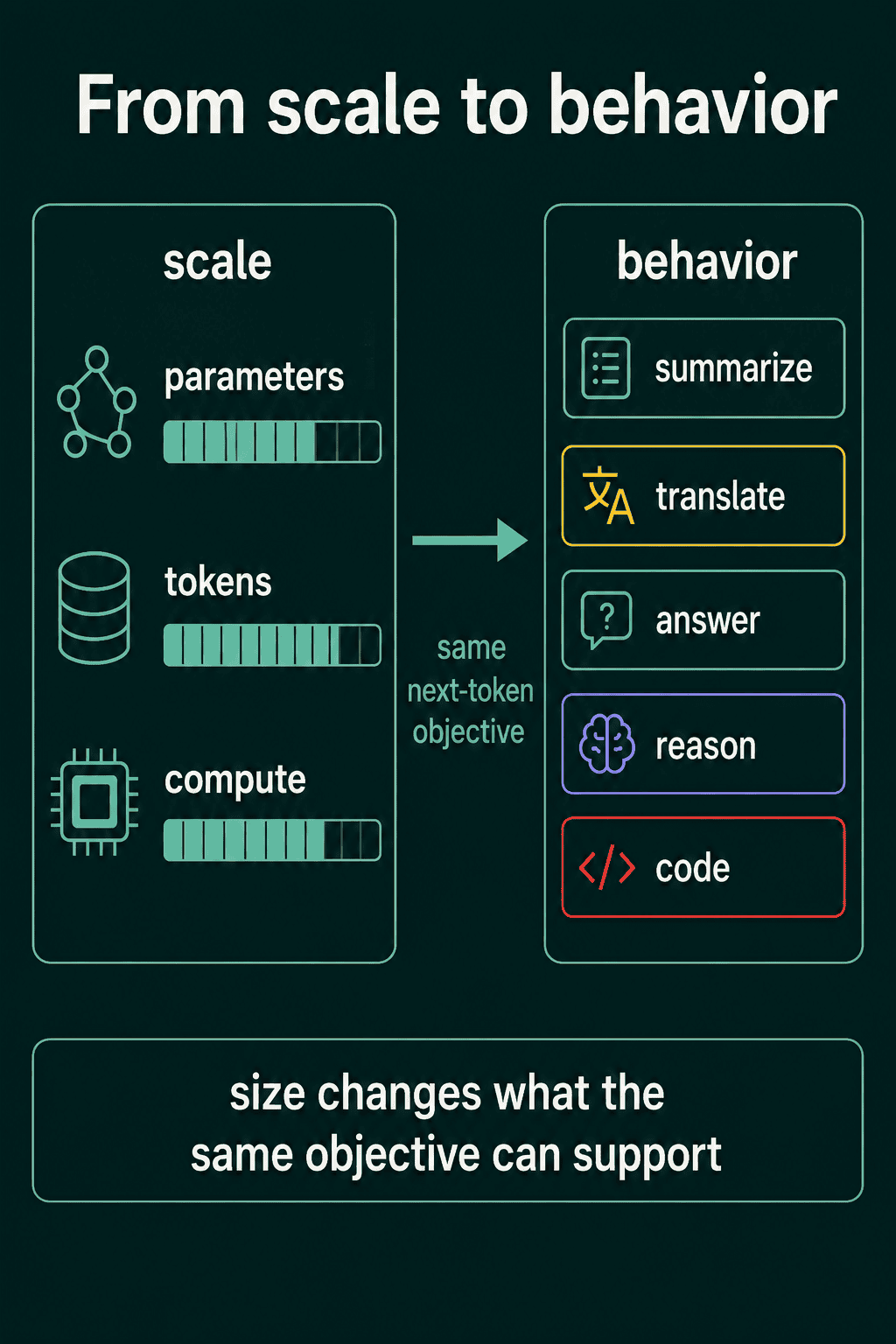
What an emergent ability looks like
An emergent ability is usually described as a capability that is weak or absent in smaller models and usable at larger scale. In the cleanest plots, task performance sits near chance for a range of model sizes. Chance is the score you would get by guessing, such as 25% on questions with four options. Past some size it improves sharply.
The training objective did not change along the way. One reading is that a larger model trained on enough data can represent or combine patterns that a smaller model cannot use well. Another is that the jump depends partly on the metric, the rule used to score the task.
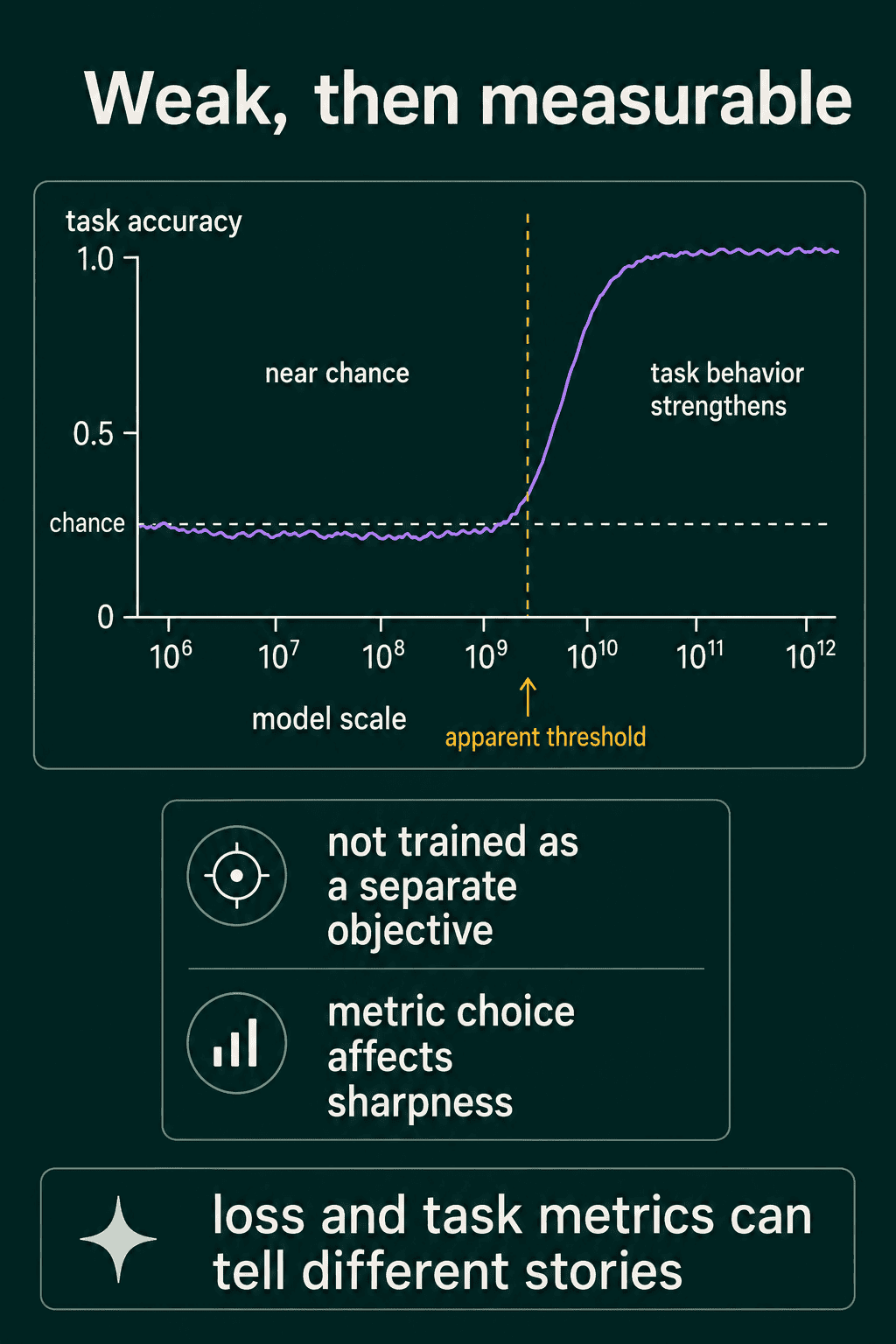
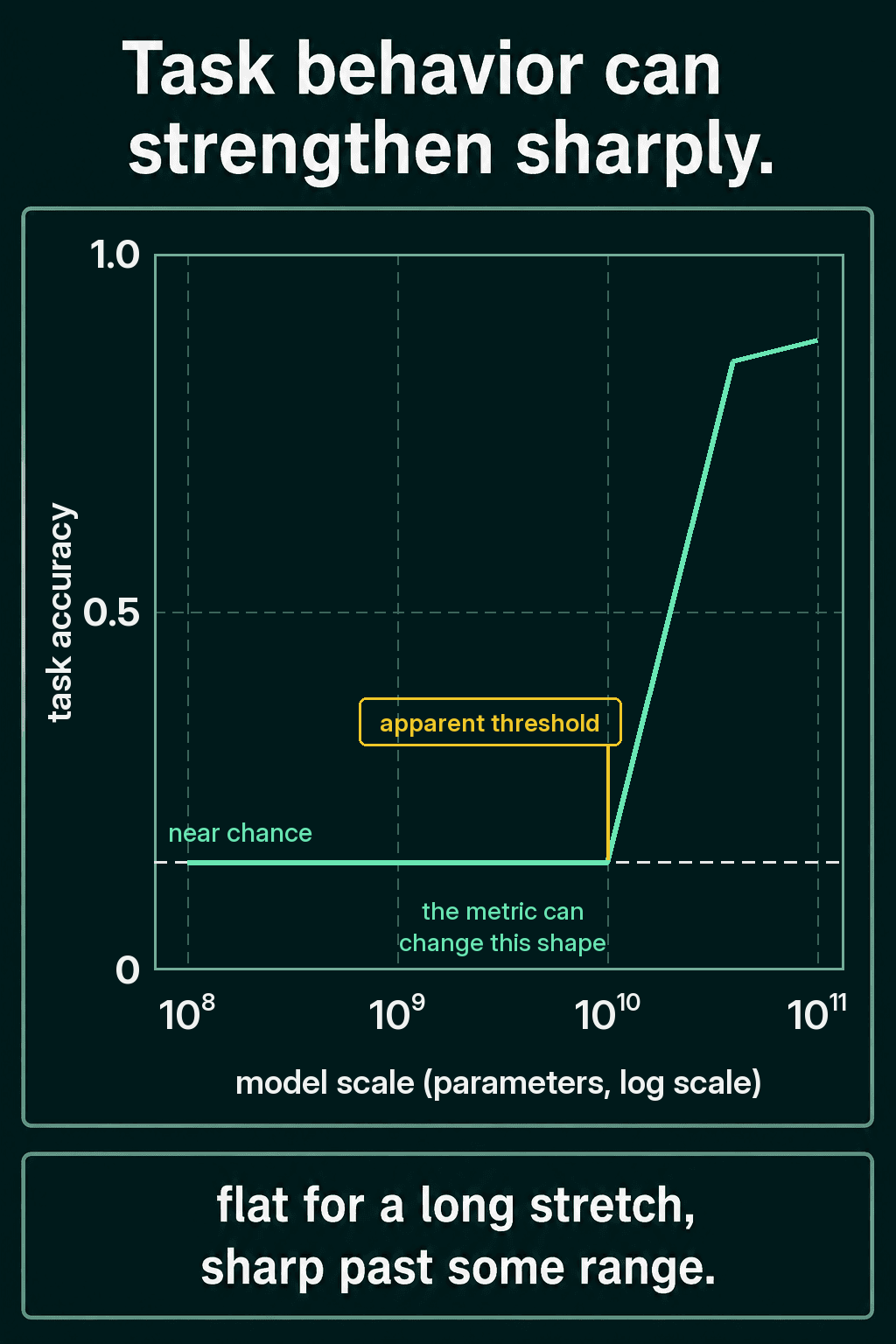
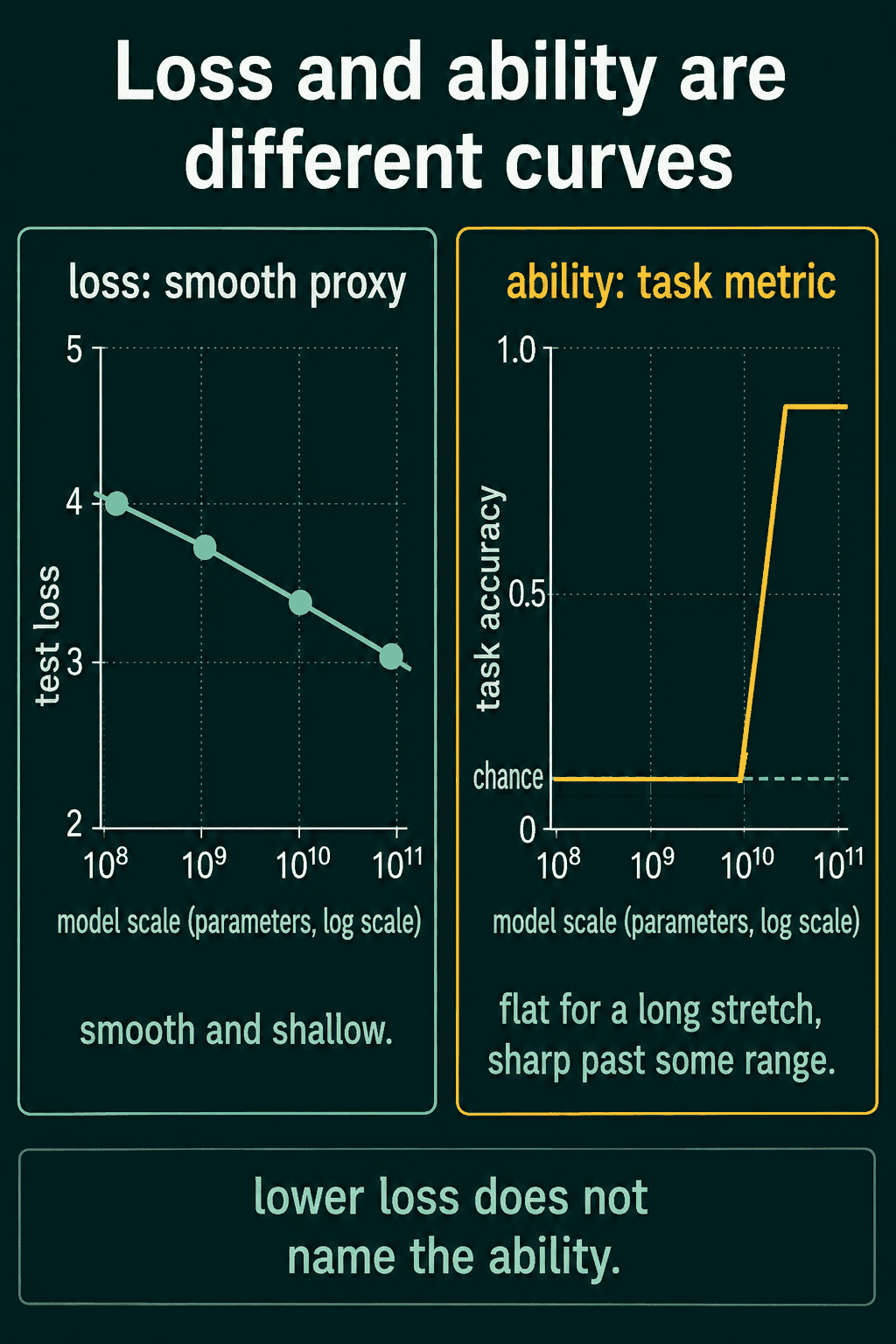
Plotted against model size on a log scale, the characteristic curve stays flat for a long stretch and then climbs. That is different from the training loss, which in many studies falls smoothly as models grow. The plot below is a schematic of that shape, not data from a real model.
Loss and ability are different curves
A model can get better at predicting the next token long before a specific task score moves. The held-out loss, the loss on text the model never trained on, may slide down smoothly. Meanwhile exact-match arithmetic, following a required output format or answering a multi-step question can sit near chance.
That is why capability evaluation is kept separate from loss tracking. A lower held-out loss is good news, and it does not tell you which task the model can now do.
Zero-shot prompting
One behavior that gets stronger with scale is zero-shot prompting, attempting a new task with no worked examples in the prompt. You phrase the task as text for the model to continue. Write a passage followed by "Summary:" and the model may continue with a summary. Write a question and it may continue with an answer. The model was not trained with a separate supervised objective for summaries, and framed as text completion it can sometimes do the task anyway. Results are uneven, especially for smaller models.

Few-shot prompting and in-context learning
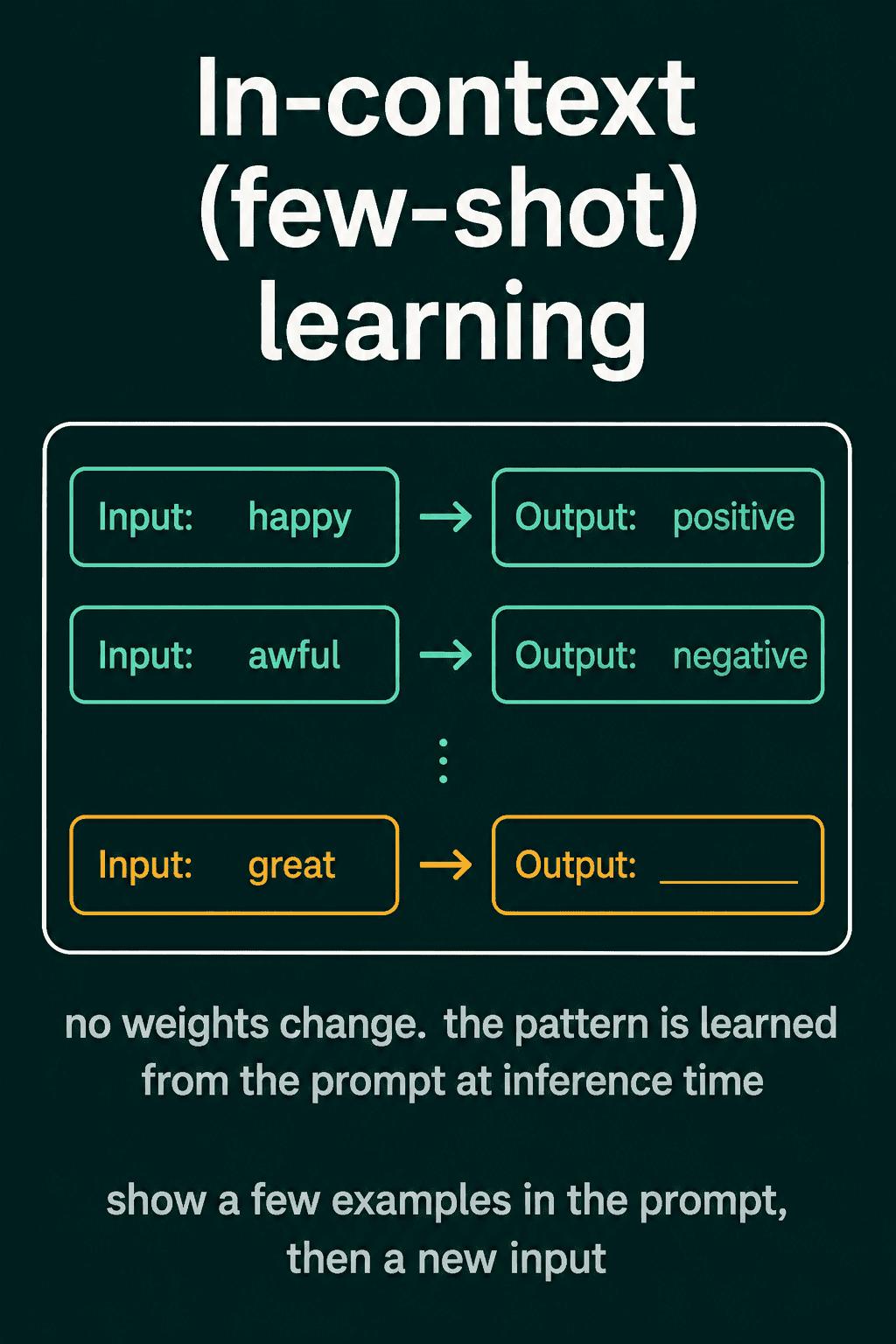
A common example of an emergent ability is in-context learning, also called few-shot prompting. You put a few worked examples in the prompt, then a new input, and the model answers in the same pattern:
1Input: happy
2Output: positive
3Input: awful
4Output: negative
5Input: great
6Output:
A model that has picked up the pattern continues with "positive". No weights change. The model adjusts its output to the examples in its context while it runs, which is called inference time, as opposed to training time.
Small models gain little from examples like these. Larger models often do much better on many tasks once a few demonstrations are added to the prompt, though the behavior is not perfectly reliable.
Instruction following and multi-step reasoning
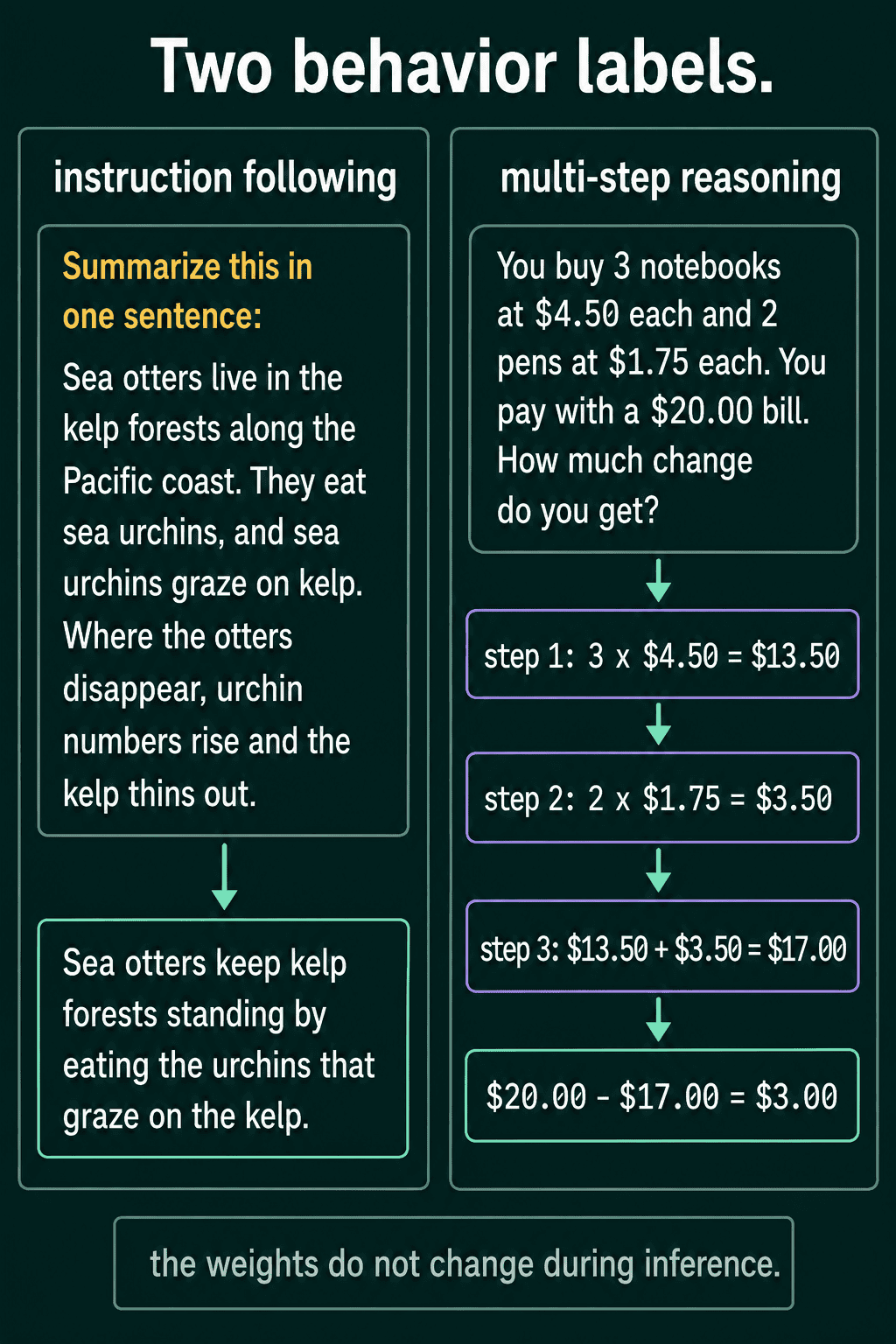
Two more behaviors tend to get stronger with scale. Instruction following means reading a plain-language request and carrying it out, so the prompt can say what to do without any examples. Multi-step reasoning means producing intermediate steps that help reach an answer a smaller model often misses. A generated trace of those steps is often called a chain of thought.
For example, take "You buy 3 notebooks at 4.50 dollars each and 2 pens at 1.75 dollars each. You pay with a 20-dollar bill. How much change do you get?" The answer is easier to get right through the steps $3 \times 4.50 = 13.50$, $2 \times 1.75 = 3.50$, $13.50 + 3.50 = 17.00$ and $20.00 - 17.00 = 3.00$. These are labels for behavior, not a recipe for making the behavior reliable.
Code and structured output
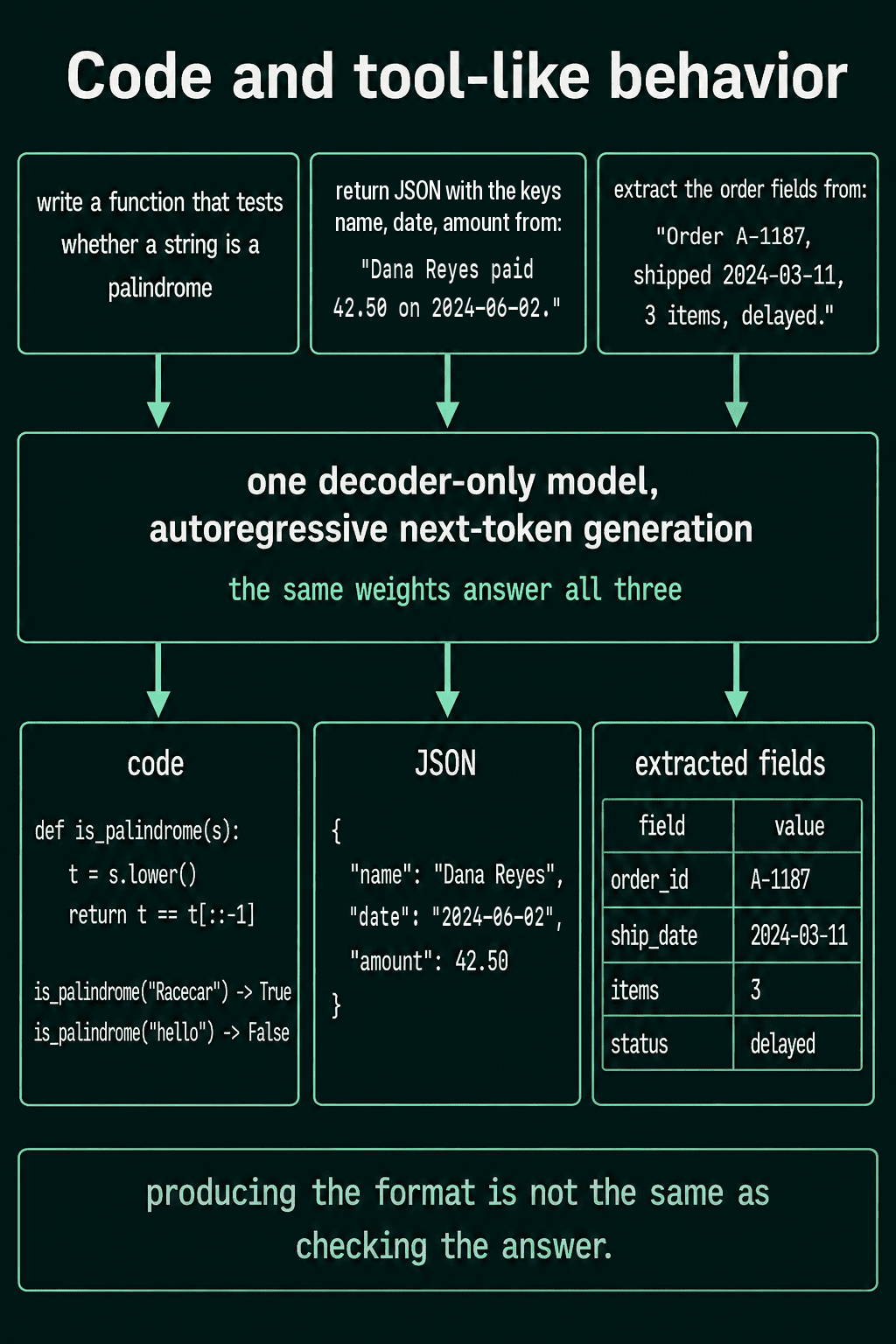
Code follows a related pattern. A next-token model trained on enough code sees imports and functions, plus tests, error messages and fixes. At small scale it may copy the syntax without keeping the program's logic. At larger scale, completing and repairing code can become useful enough to measure.
The same goes for turning text into a fixed format: a request into JSON, a messy paragraph into named fields, or a support ticket into a category. The model was still trained only to predict tokens. Scale can make format and task control stronger, especially when later training and evaluation are added. Output in the right format can still hold the wrong values, so producing the format is not the same as checking the answer.
Is emergence real?
Two caveats come with emergent abilities.
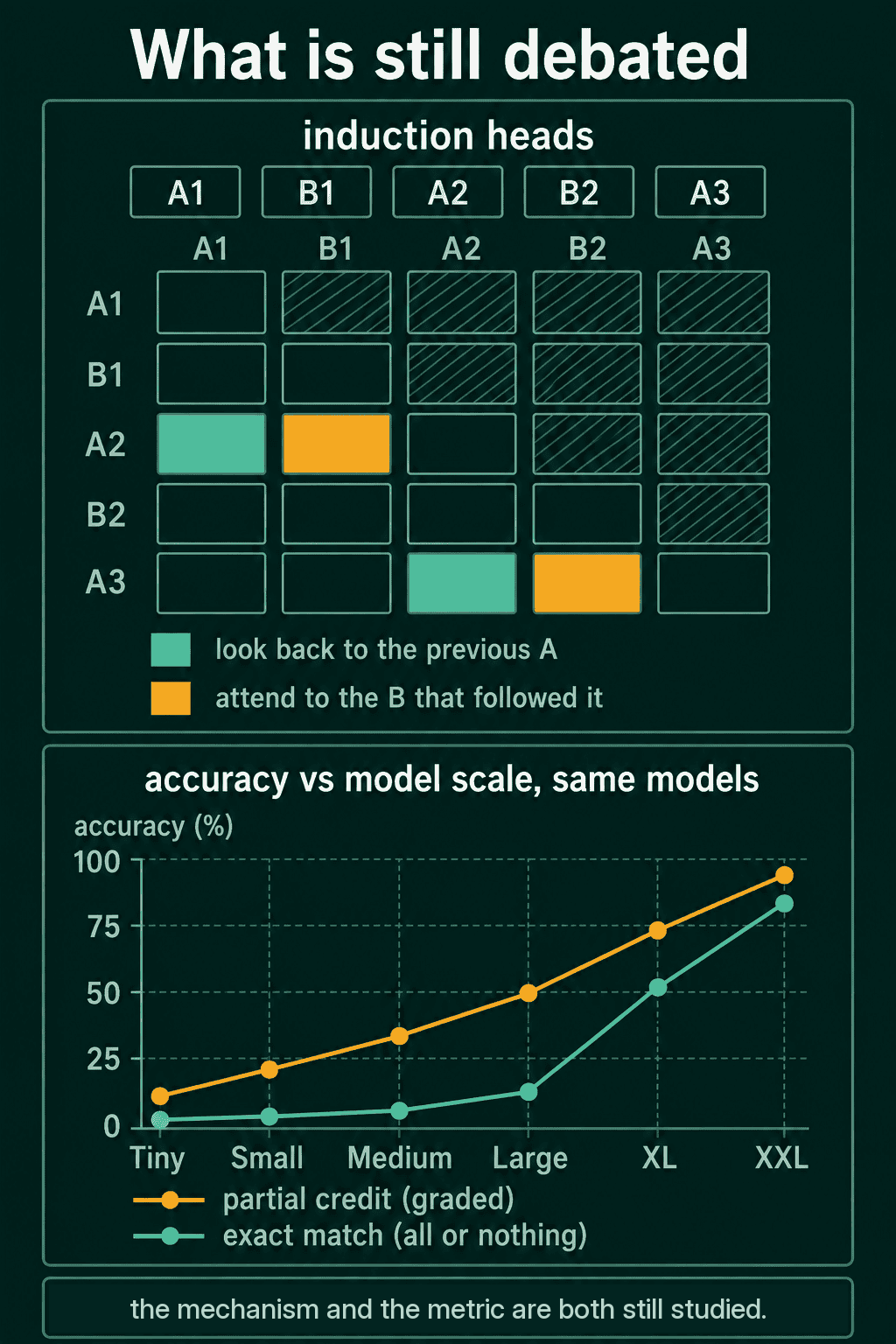
First, in-context learning is still not fully understood. One partial explanation points to induction heads, attention heads that find an earlier copy of the current token and predict the token that came after it. Take the sequence A1 B1 A2 B2 A3. At A2 the head looks back to A1, the previous A. It then attends to B1, the token that followed A1, and predicts that a B comes next. That copies a pattern from earlier in the context without any weight update.
Second, some reported emergence may come partly from how the task is scored. An exact-match metric gives credit only when the whole answer is right. Suppose each token of a 10-token answer is right with probability $p$, independently of the others. The exact-match score is then $p^{10}$:
1answer_length = 10
2for p in [0.5, 0.7, 0.8, 0.9, 0.95, 0.99]:
3    exact = p ** answer_length
4 print(f"per-token accuracy {p:.2f} -> exact match {exact:.3f}")1per-token accuracy 0.50 -> exact match 0.001
2per-token accuracy 0.70 -> exact match 0.028
3per-token accuracy 0.80 -> exact match 0.107
4per-token accuracy 0.90 -> exact match 0.349
5per-token accuracy 0.95 -> exact match 0.599
6per-token accuracy 0.99 -> exact match 0.904Per-token accuracy climbs steadily from 0.50 to 0.99. Exact match stays below 0.03 for the first two rows and then climbs fast. A model that improves gradually with size can look like it does nothing and then suddenly works. Scored with partial credit, the same outputs can show a gradual climb. Whether emergence is a real jump, an effect of the metric or a mix of both is still debated.
Common mistakes
- Expecting an ability at a fixed size. There is no known parameter count where a given task switches on. Where a jump appears depends on the task, the data and the metric.
- Judging emergence from one strict metric. Score the same outputs with exact match and with a softer metric, such as partial credit, before calling a jump sharp.
- Treating few-shot prompting as training. The examples change the input, not the weights. Remove them and the behavior goes away.
- Trusting a falling loss as proof of a skill. Evaluate the task you care about directly.
- Trusting a well-formed answer. Valid JSON or code that runs can still be wrong, so check the values and run the tests.
Related concepts
How do LLMs work? covers the pretraining that these behaviors come from. Scaling laws explained covers the smooth side of scale, how loss falls with parameters, data and compute. LLM decoding strategies covers how the next token is picked when a model generates its answer.
QuiddityML teaches emergent abilities as one concept in the Intro to NLP track. One exercise on it is ordering the steps to test whether an apparent emergent ability is real or partly a scoring effect: score the same outputs strictly and with partial credit, then plot both against model scale.