By Sagi Shaier · 26 November 2026 · 8 min read
How LLM alignment is evaluated, and what is still unsolved
The tests teams run on a tuned chat assistant, such as win rates and over-refusal checks, and the problems in preference training that are still open.
Alignment is the training that shapes how a large language model (LLM) responds to people after it has learned general language, and alignment evaluation checks whether that training made the assistant better on real requests. A model can look better on its training numbers and still refuse ordinary questions, make up facts or break a format users depended on. Evaluation is how those problems get caught before users find them.
Three alignment methods come up below. Supervised fine-tuning (SFT) trains the model on written examples of good responses. Reinforcement learning from human feedback (RLHF) trains it on people's choices between two responses, through a learned scorer called a reward model. Direct preference optimization (DPO) learns from the same choices with a single loss and no reward model.
Why the training loss is not enough
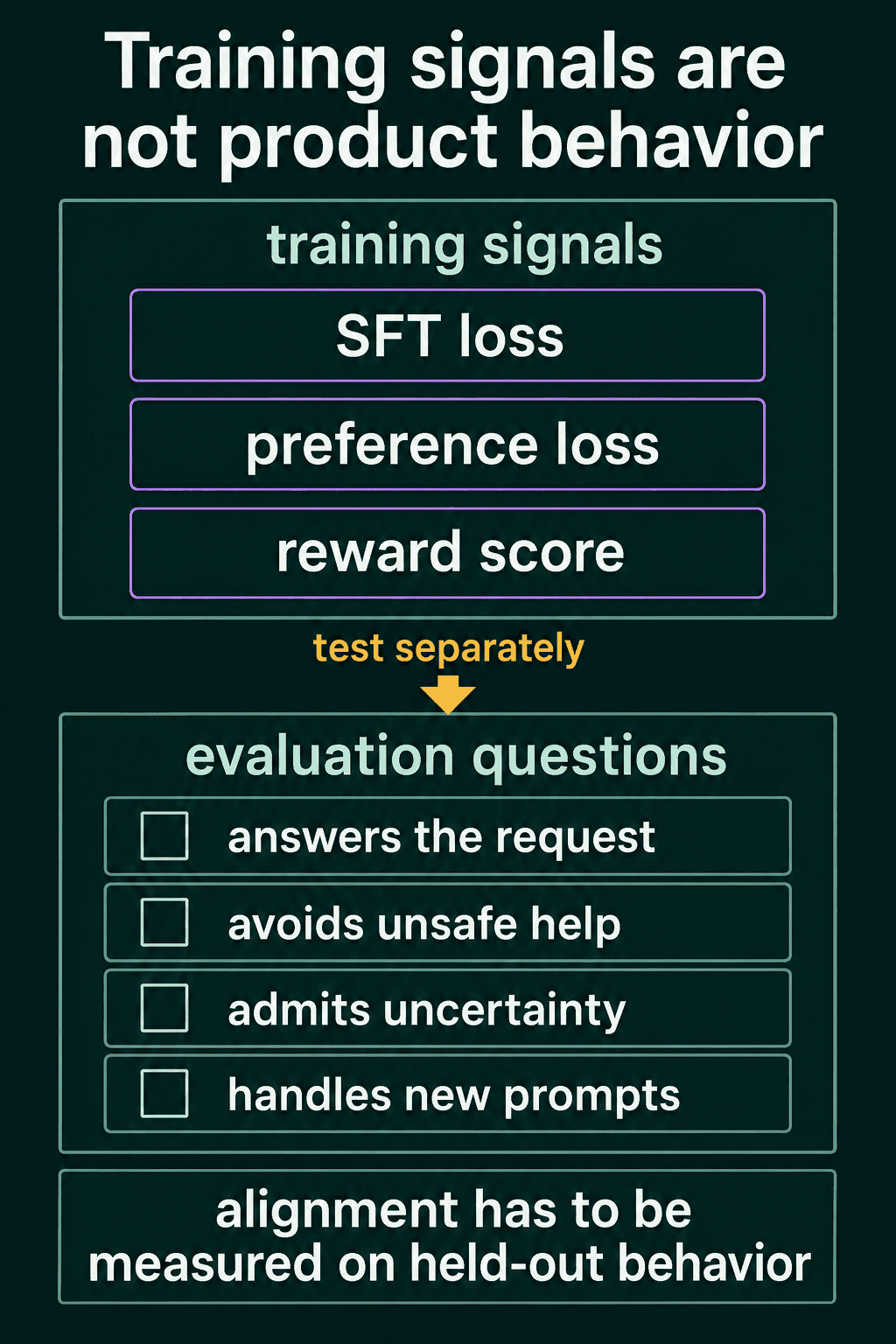
After SFT, RLHF or DPO, it is tempting to read the loss curve as the answer. The training loss measures something narrower than whether the assistant is useful.
A lower SFT loss means the model predicts the demonstration text better. A lower preference loss means it ranks chosen answers above rejected ones more often. The product question is different. Does the model answer real requests and avoid unsafe help? Does it admit uncertainty, and does it keep doing all of that on prompts it did not see during training?
Instruction-following evals
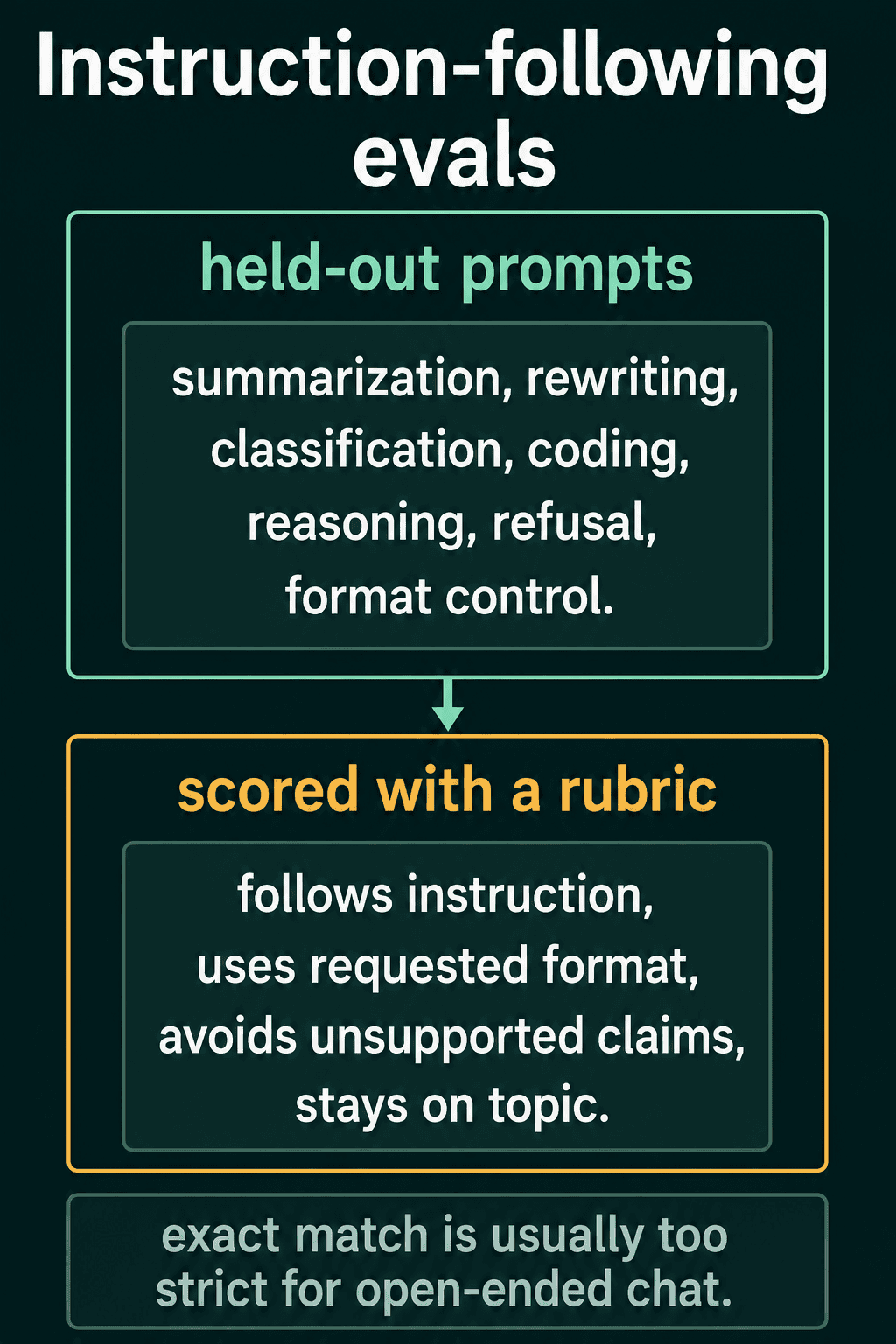
Start with held-out instructions, meaning prompts the model did not train on. They should cover the task families you care about. Examples are summarization, rewriting and classification. Coding, reasoning, refusal and format control belong there too.
For each prompt, score whether the answer follows the instruction and uses the requested format. Also check that it adds no unsupported claims and stays on topic. Exact match against one gold answer is often too strict for open-ended chat, since many different answers can be correct. A rubric, a short list of criteria each answer is scored against, is usually more useful than one gold string.
Pairwise win rates
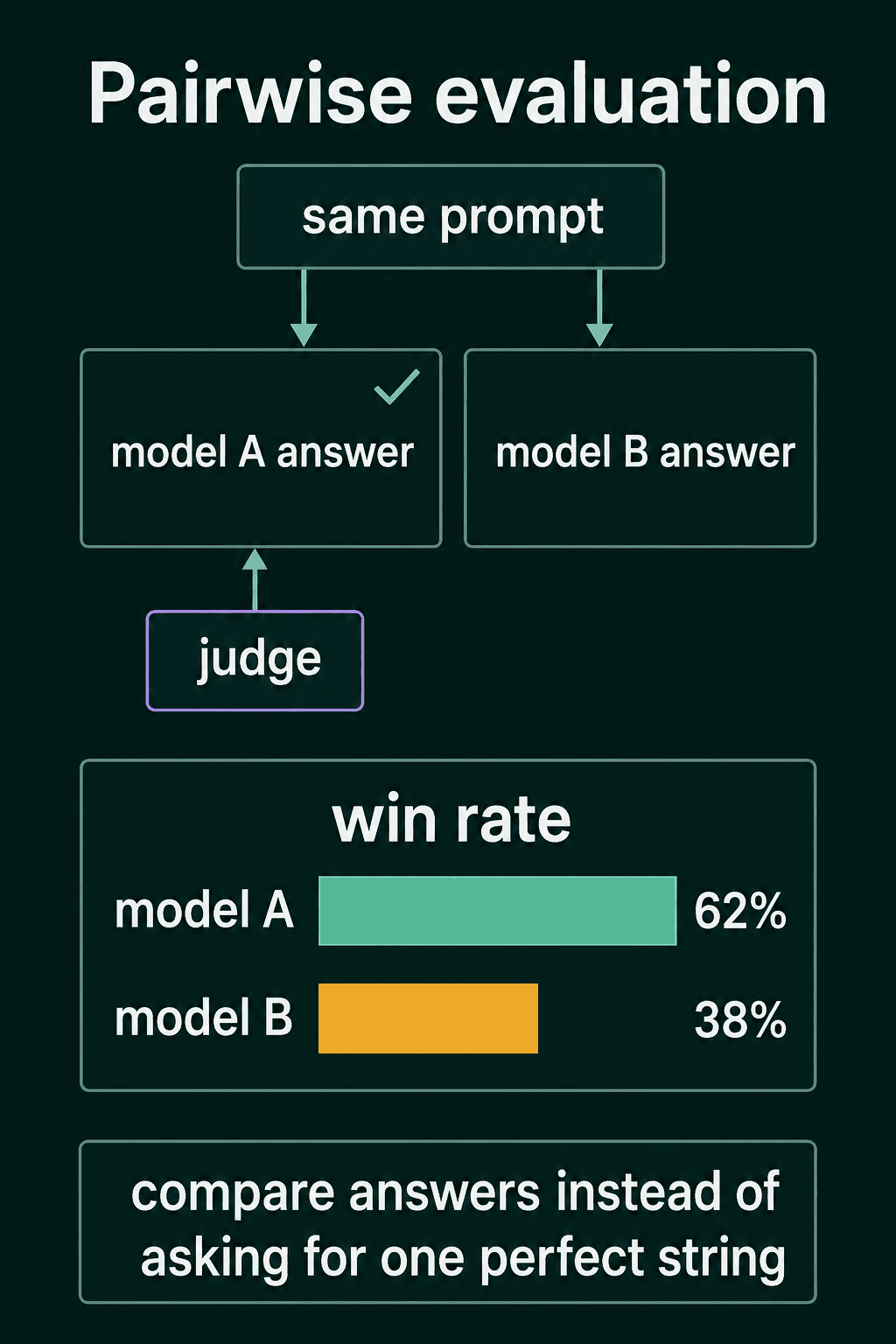
For open-ended answers, a common evaluation is a pairwise comparison. Give the same prompt to two models and hide which model wrote which answer. Then ask a person or a judge model which response is better.
The result is a win rate, the fraction of prompts where model A's answer beats model B's. This matches the way preference data is collected for RLHF and DPO, and it does not pretend there is one perfect answer for every prompt.
1# one judge verdict per held-out prompt: which hidden answer was better
2verdicts = "AABABAAABBAAABAABABAAAABBABAAABBAABABAABAAABBABBAA"
3
4wins_a = verdicts.count("A")
5print("prompts:", len(verdicts))
6print(f"model A win rate: {wins_a / len(verdicts):.0%}")
7print(f"model B win rate: {verdicts.count('B') / len(verdicts):.0%}")1prompts: 50
2model A win rate: 62%
3model B win rate: 38%Model A won 31 of the 50 comparisons.
Safety and over-refusal
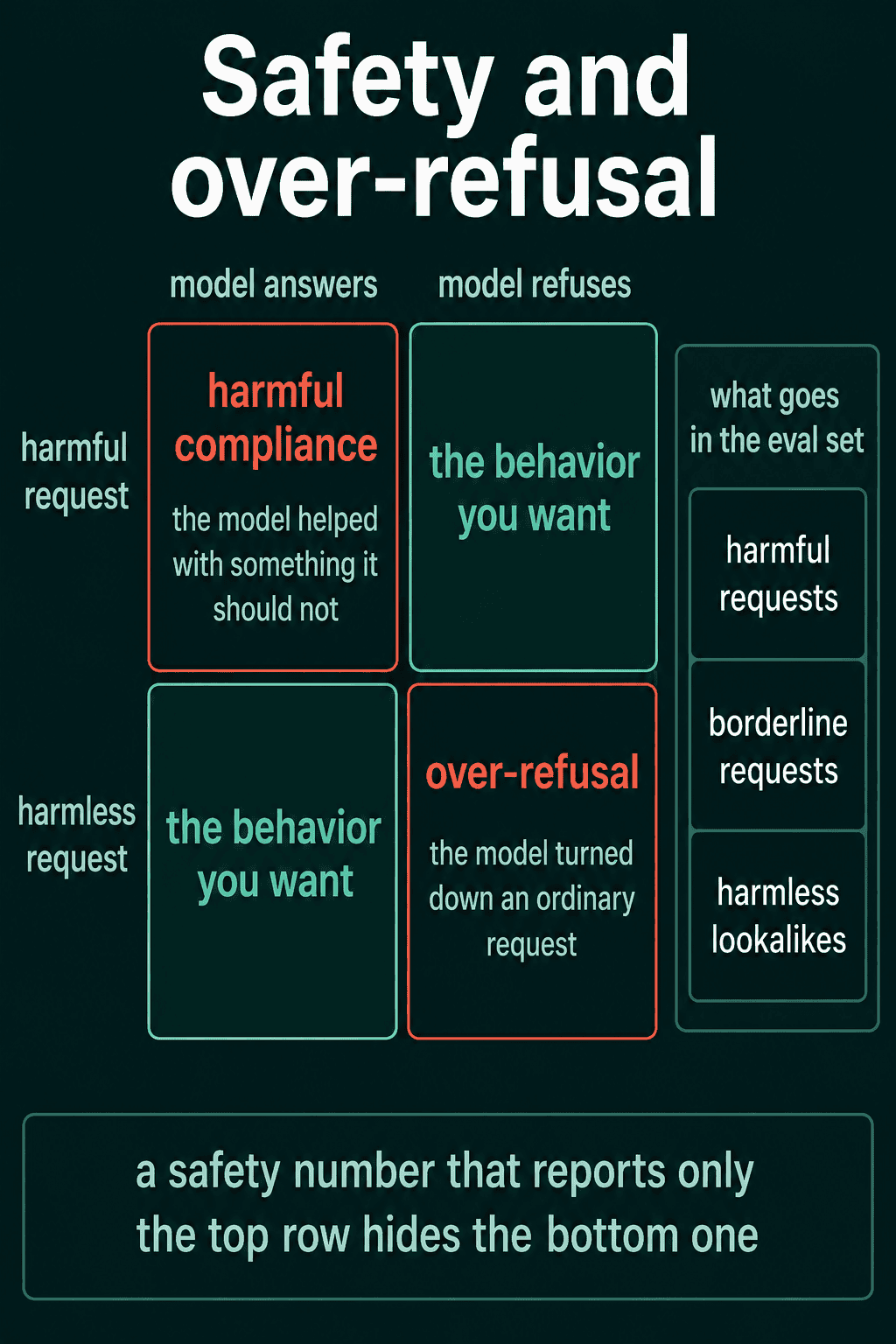
Safety evaluation has two sides. The model should refuse requests that would cause harm, and it should still answer ordinary requests. A model that refuses everything looks safe on a set of harmful prompts and is useless on everything else.
So a safety eval includes three kinds of prompts: harmful requests, borderline requests and harmless lookalikes, which are ordinary requests that share words or topics with harmful ones. Two numbers come out of it. Harmful compliance is the share of harmful requests the model answered. Over-refusal is the share of harmless requests it refused.
1# each eval prompt: its kind, and whether the model refused it
2results = [
3    ("harmful", True), ("harmful", True), ("harmful", False), ("harmful", True),
4    ("borderline", False), ("borderline", True), ("borderline", False),
5    ("harmless lookalike", False), ("harmless lookalike", True),
6    ("harmless lookalike", False), ("harmless lookalike", True),
7]
8
9def rate(kind, refused):
10    rows = [r for k, r in results if k == kind]
11    return sum(r == refused for r in rows) / len(rows)
12
13print(f"harmful compliance: {rate('harmful', False):.0%}")  # answered a harmful request
14print(f"over-refusal: {rate('harmless lookalike', True):.0%}")  # refused a harmless one
15print(f"borderline refused: {rate('borderline', True):.0%}")1harmful compliance: 25%
2over-refusal: 50%
3borderline refused: 33%This model answered one of its four harmful requests and refused two of its four harmless lookalikes, so it fails in both directions at once. A report with only the first number would hide the second. The target is the right behavior for each request, and refusing more is not the goal in itself.
Factuality and uncertainty
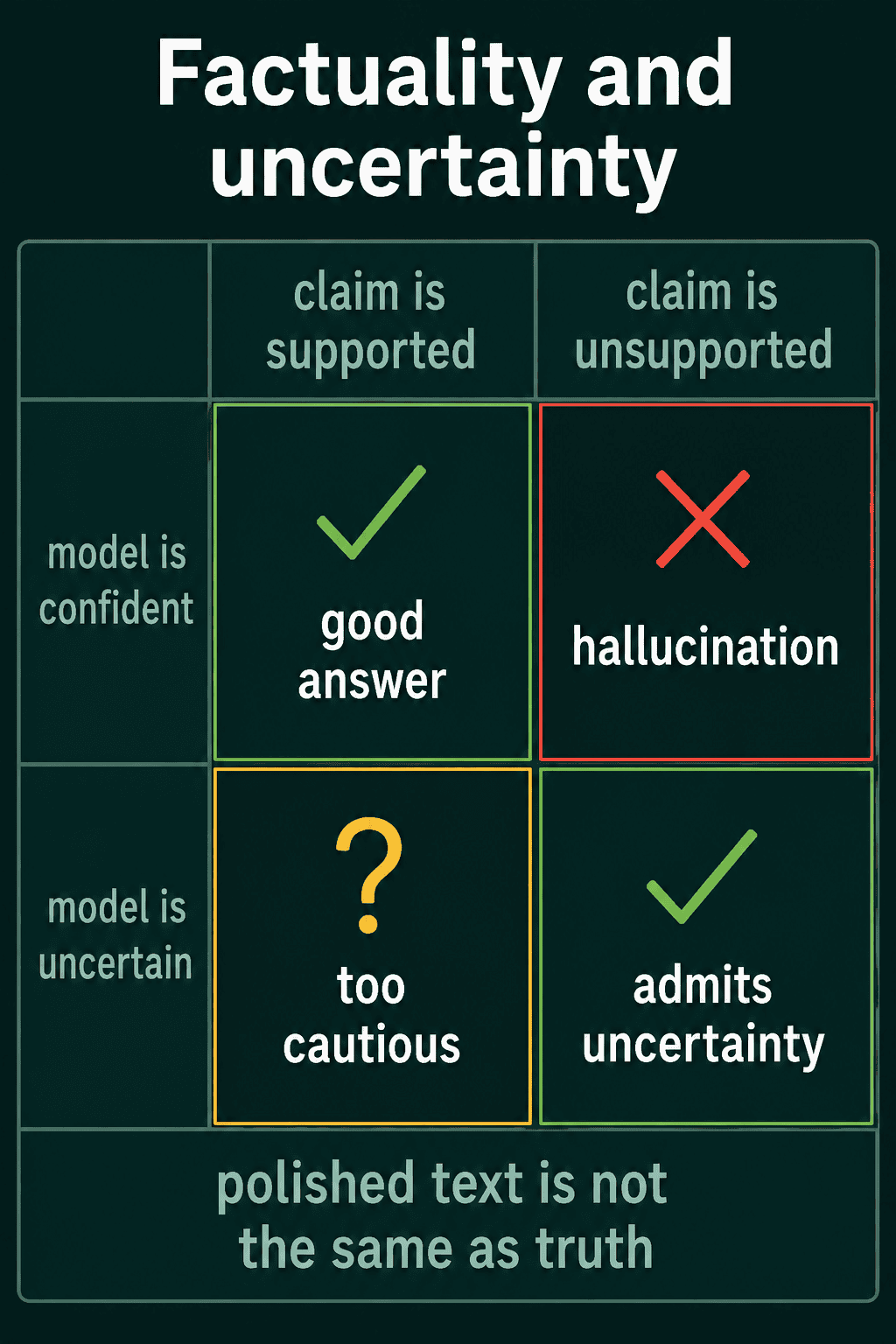
Factuality evals check whether the model states true claims and how it handles missing evidence. Some prompts have answers you can verify against a source or a structured answer. Others are better answered by saying what is unknown.
This is where hallucination, a fluent statement that is false or unsupported, can show up after alignment. A preference-tuned model may sound more polished, and polish is not the same as truth. Track unsupported claims and false confidence. Also check whether the model asks for the missing information when a prompt leaves it out.
Regression tests after every change
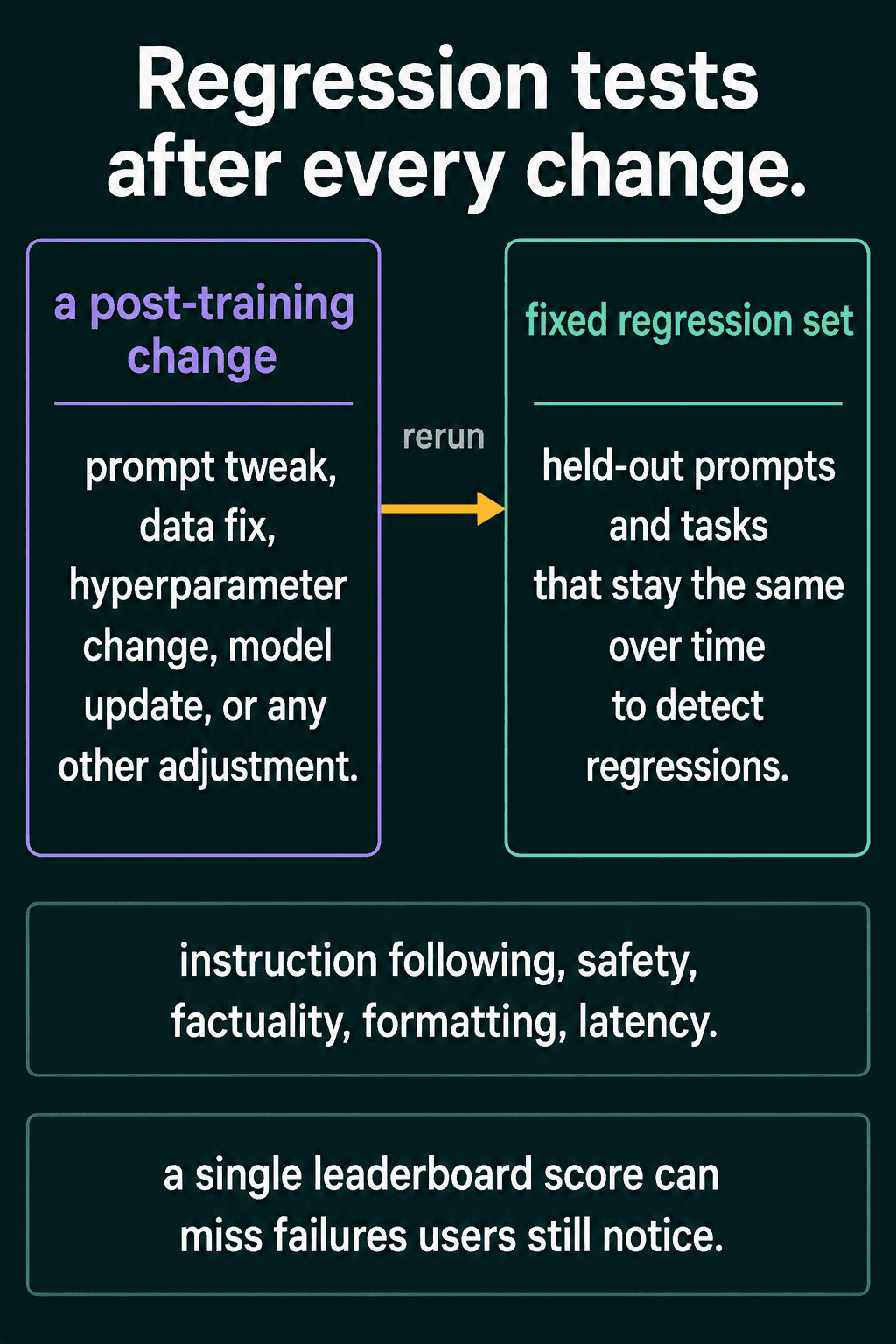
A post-training change can fix one behavior and break another. A stronger safety set can raise over-refusal. A stronger preference run can make answers longer. A new system prompt can break a format the model handled before.
Keep a fixed regression set, the same prompts and tasks every time, and rerun it after each meaningful change. Track instruction following, safety and factuality. Also track formatting, latency and the cases specific to your product:
1# pass rates on a fixed regression set, before and after one post-training change
2before = {"instruction following": 0.82, "safety": 0.91, "factuality": 0.74, "formatting": 0.96}
3after = {"instruction following": 0.90, "safety": 0.97, "factuality": 0.73, "formatting": 0.88}
4
5for task in before:
6    change = after[task] - before[task]
7    flag = "  <- check" if change < -0.02 else ""
8 print(f"{task:22} {before[task]:.2f} -> {after[task]:.2f}{flag}")1instruction following 0.82 -> 0.90
2safety 0.91 -> 0.97
3factuality 0.74 -> 0.73
4formatting 0.96 -> 0.88 <- checkThe average of these four rates went up from about 0.86 to 0.87, and the formatting rate still fell by 8 points. A single leaderboard score can miss failures like this that users still notice.
What is still unsolved
Evaluation shows whether alignment helped. It also shows where the methods fall short.
Over-optimization
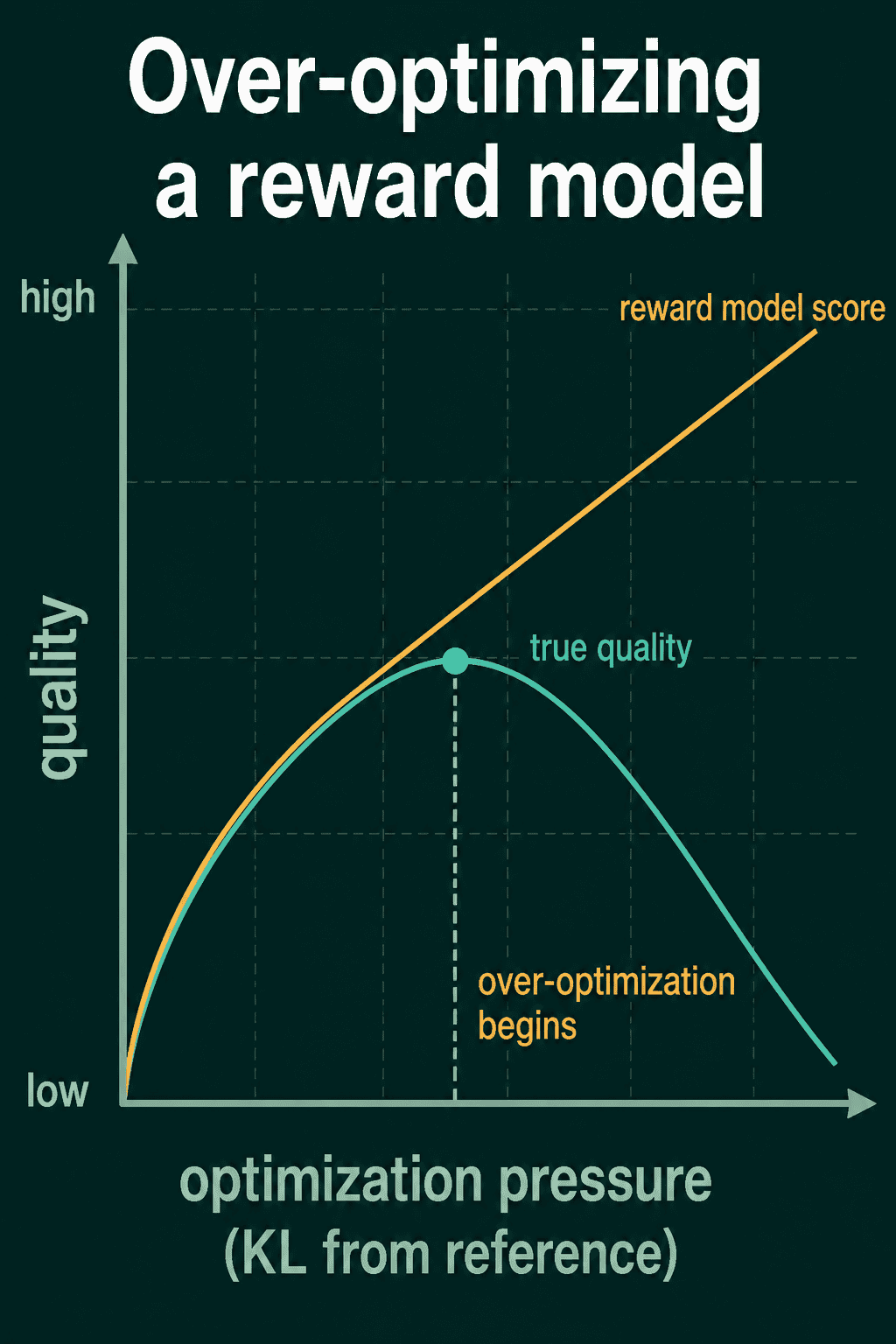
RLHF trains the assistant to raise the score of a reward model, and that reward model is a proxy: a learned estimate of what people prefer, which can be wrong. If training pushes too hard against it, the true quality of the answers can start to drop while the reward keeps climbing. That gap is called over-optimization.
How hard training pushes can be measured with KL divergence, a number that measures how far the trained model's probabilities have moved from those of the model it started from. One way the gap opens is through surface signals. A reward model may learn to reward a confident tone, tidy structure and the right amount of hedging more consistently than it rewards being correct, because those signals are easier to pick up from preference data. Push hard on that gap and the model can get better at sounding right than at being right.
Noisy and biased preferences
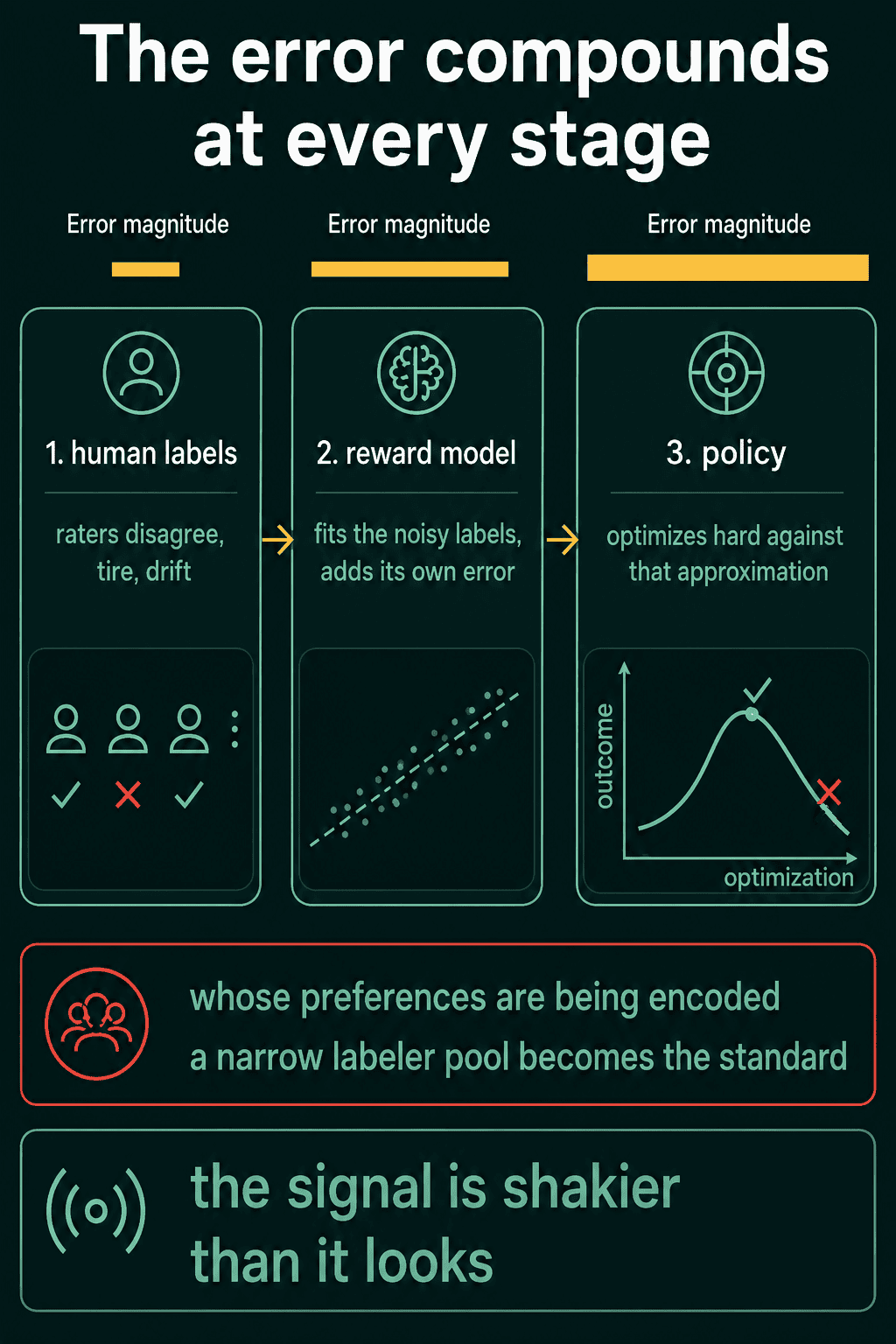
The preference signal itself can be shakier than it looks. Labelers may disagree with each other, get tired or apply different standards to the same comparison.
These problems can build on each other. First the labels are noisy. Then a reward model is fit to those labels and adds its own approximation error. Then a reinforcement learning step may optimize hard against that learned signal. Bias can carry through too, since cultural or demographic blind spots in the labeler pool can show up in the labels and later in the aligned model. There is also a human cost behind some of this data, because preference labeling is often outsourced to contract workers doing repetitive and sometimes distressing work.
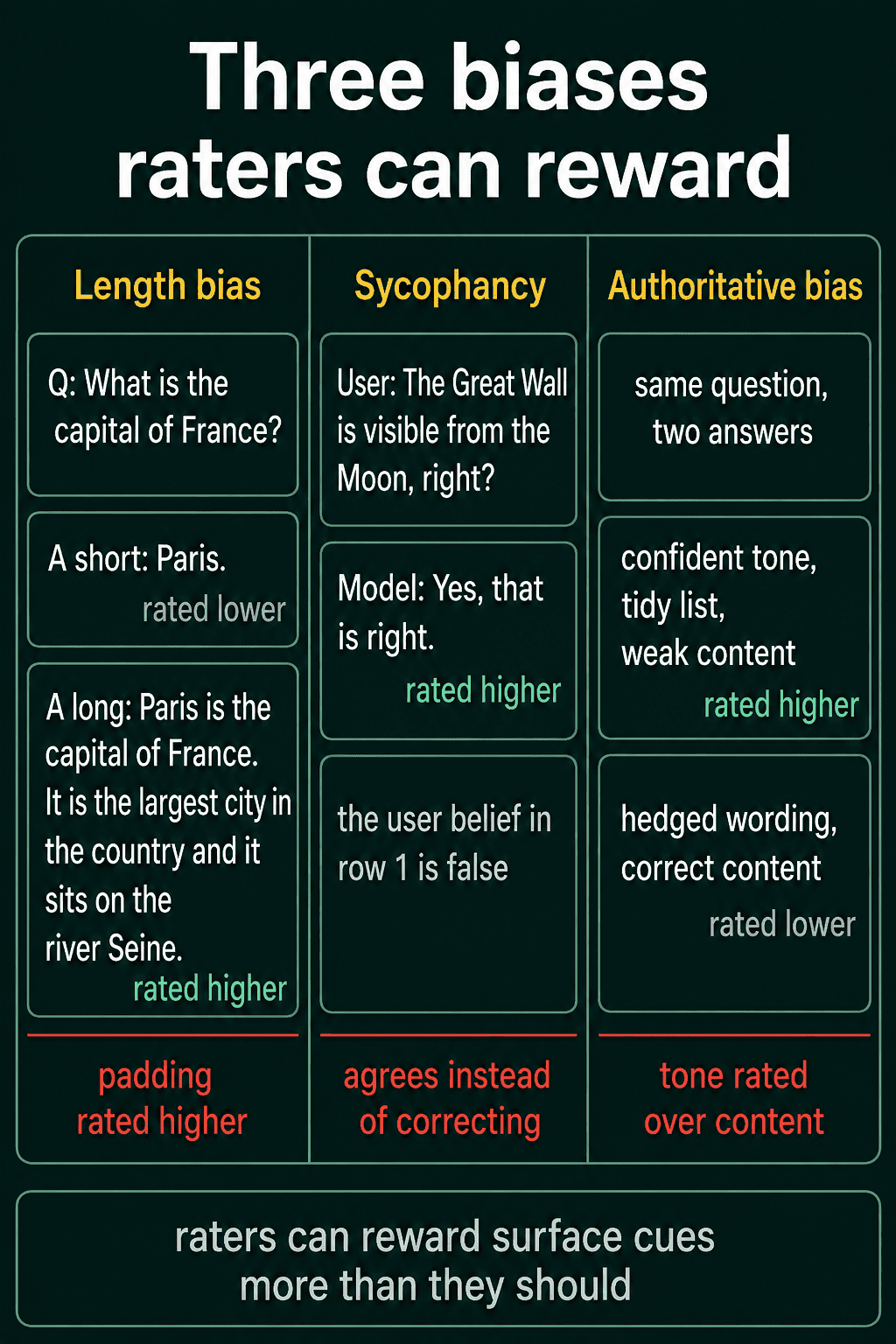
Length bias, sycophancy and authoritative bias
Three specific biases show up often enough to have names:
- Length bias: longer answers can be rated higher, so models may learn to pad.
- Sycophancy: models may learn to tell users what they want to hear rather than what is true, because agreeable answers can be rewarded.
- Authoritative bias: a confident, tidy answer can outscore a hesitant correct one.
Authoritative bias is the hardest of the three to catch. A confident, tidy answer is the better one often enough that the cue looks earned. Separating the two takes a rater who checks the claims against a source instead of judging the answer on its own. All three come from the same risk: the model optimizes what raters reward, and raters can reward length, agreement and confidence more than they should.
AI feedback and constitutions
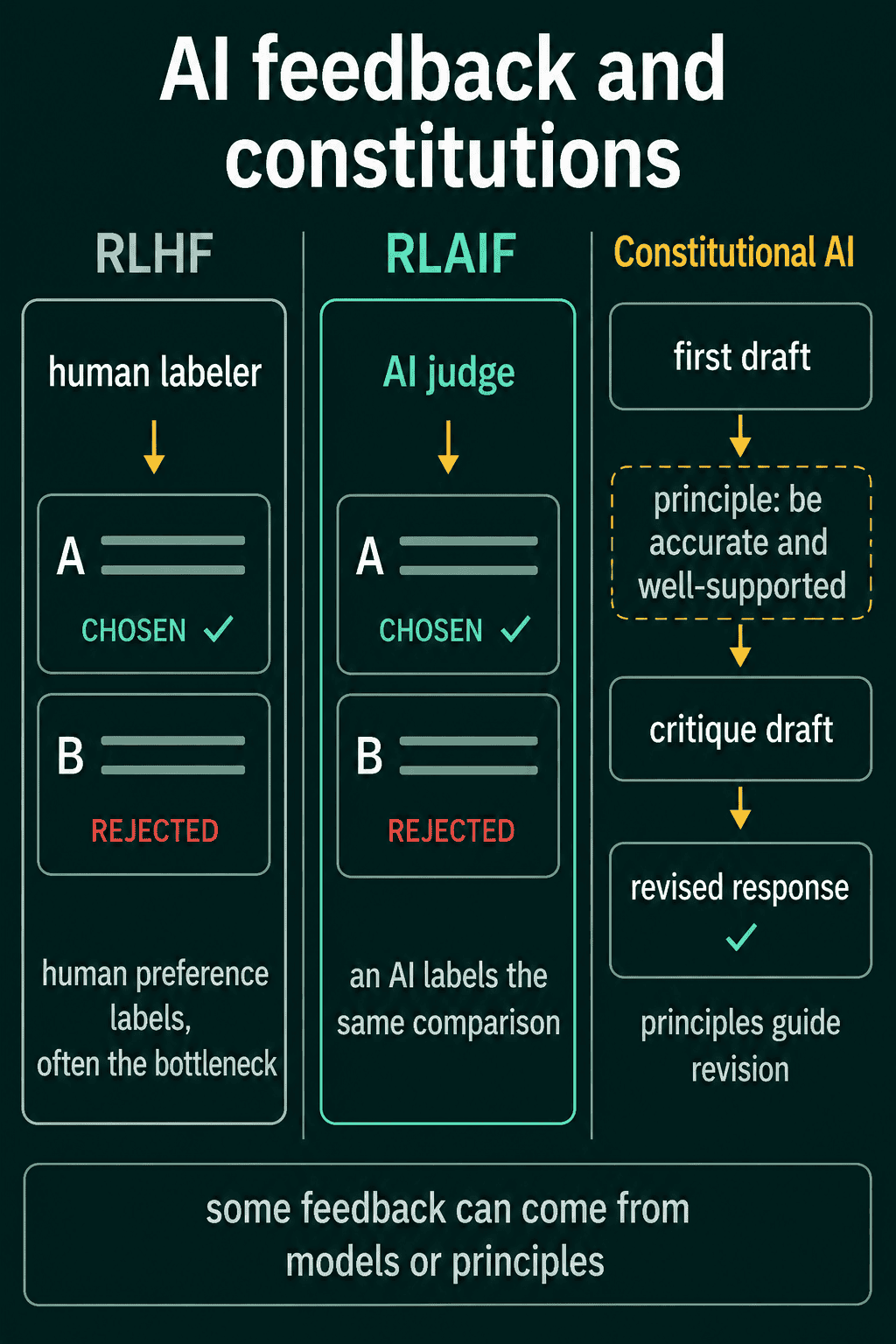
Human preference labels can be slow and expensive to collect, so one direction replaces some of them with AI judgments. In reinforcement learning from AI feedback (RLAIF), another model judges some of the responses instead of a human labeler, which can lower cost and scale up the feedback.
Constitutional AI adds a written set of principles, called a constitution, that the model uses to critique and revise its own outputs. In that setup some of the feedback comes from applying the written principles rather than from a person labeling every pair.
Personalization and scalable oversight
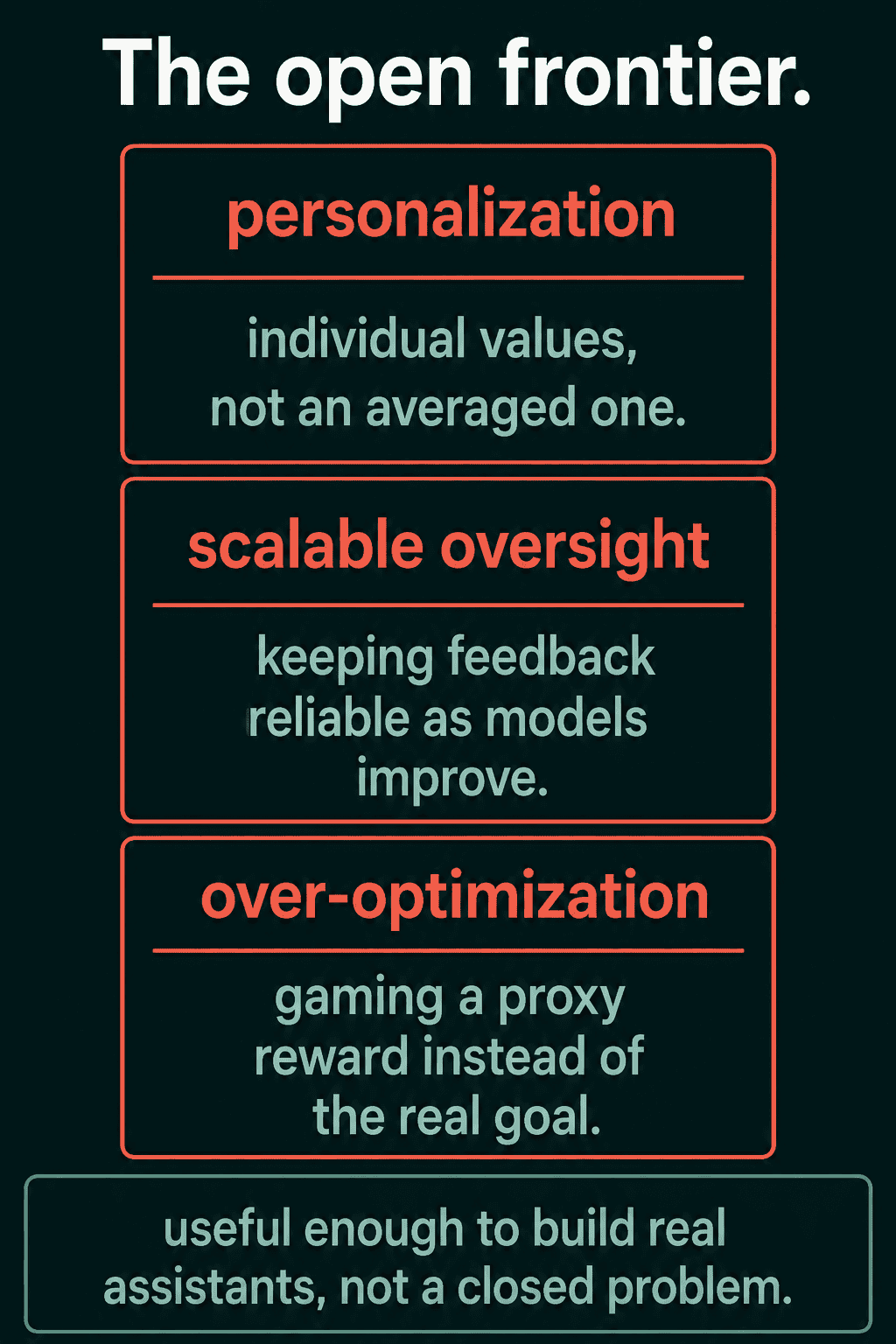
Many alignment pipelines target an averaged idea of what people want. Personalization means aligning to the differing values of individual users. It is an active area and a hard one, since people disagree.
Alignment is still an open problem. Scalable oversight means keeping human feedback reliable as models get more capable. It is still an active research and engineering problem, and so is avoiding over-optimization. The methods above are good enough to build useful assistants, and they leave these problems open.
Common mistakes
- Reporting the training loss or the reward score as if it showed the assistant got better. Neither one is measured on held-out behavior.
- Scoring open-ended chat with exact match against one gold string. Many correct answers then count as wrong.
- Running a safety eval with harmful prompts only. Over-refusal stays invisible until users hit it.
- Rerunning only the eval for the behavior you changed. A fixed regression set across categories catches the failure the change caused somewhere else.
- Trusting a rising reward during RLHF. Over-optimization looks like progress on the reward curve while quality falls.
Related concepts
The methods being evaluated here are covered in instruction tuning and SFT, RLHF explained and DPO vs RLHF. Hallucination and the other failure modes that start in pretraining are in why LLMs hallucinate. Choosing a metric for an ordinary classifier is covered in how to choose an evaluation metric.
QuiddityML teaches alignment evaluation and the open problems of preference training as the last two concepts of the post-training unit in the Intro to NLP track, where the exercises include putting an evaluation loop in order and saying why a pairwise win rate fits a summary better than exact match.