Math for ML
Linear algebra, calculus, probability, and information theory, as ML uses them. Posts are listed in the order the ideas build on each other.
Math toolkit and notation
 Math toolkit and notation
How to read the math notation in ML papers
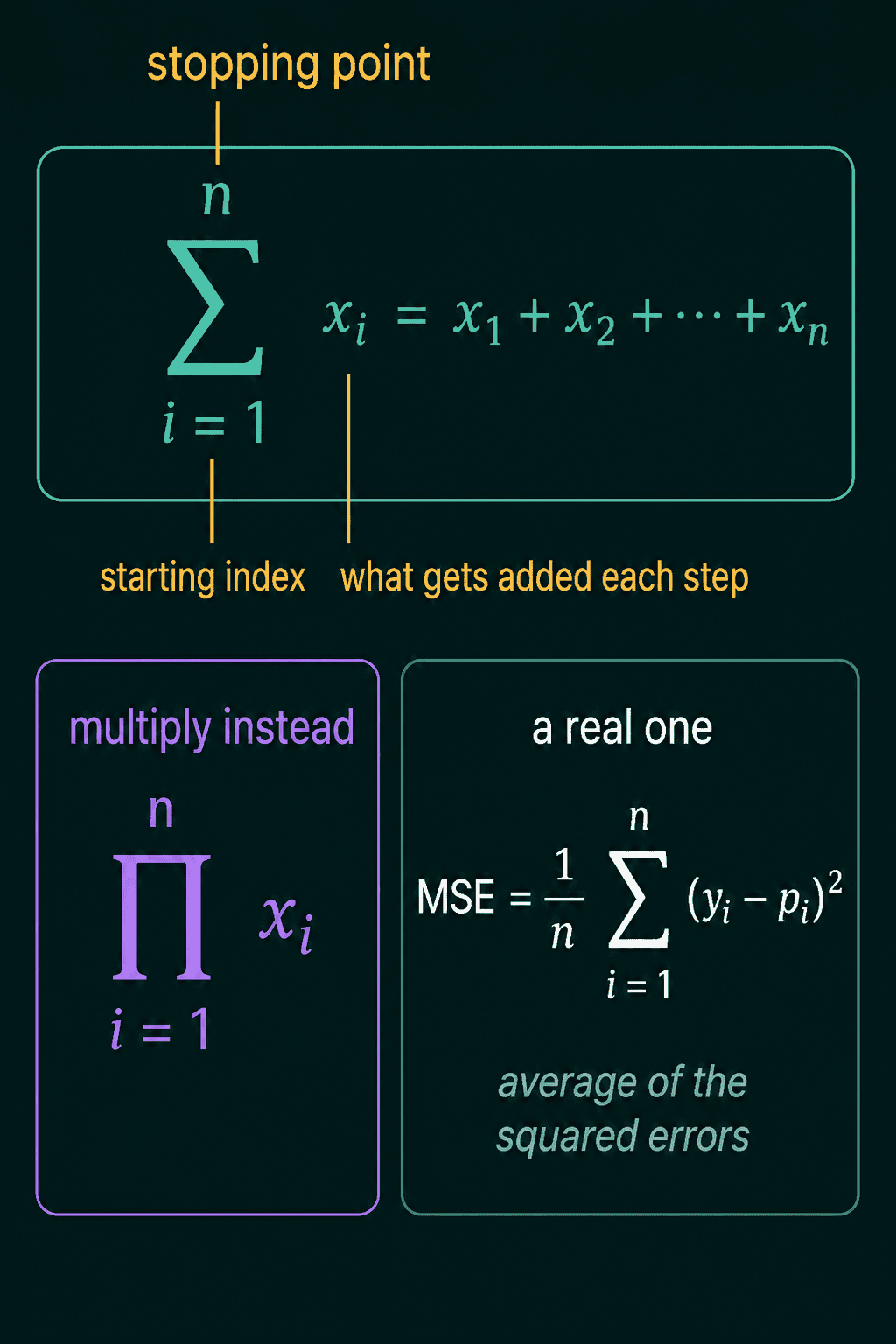
Machine learning papers write their formulas with a small set of symbols: big sigma and pi, argmin and argmax, hats and bars over letters, a left arrow, and shape declarations like W ∈ ℝ^(m×n). This post explains what each one means and shows the PyTorch line that does the same thing.
Math toolkit and notation
How to read the math notation in ML papers
Machine learning papers write their formulas with a small set of symbols: big sigma and pi, argmin and argmax, hats and bars over letters, a left arrow, and shape declarations like W ∈ ℝ^(m×n). This post explains what each one means and shows the PyTorch line that does the same thing.
 Math toolkit and notation
Exponents and logarithms for machine learning
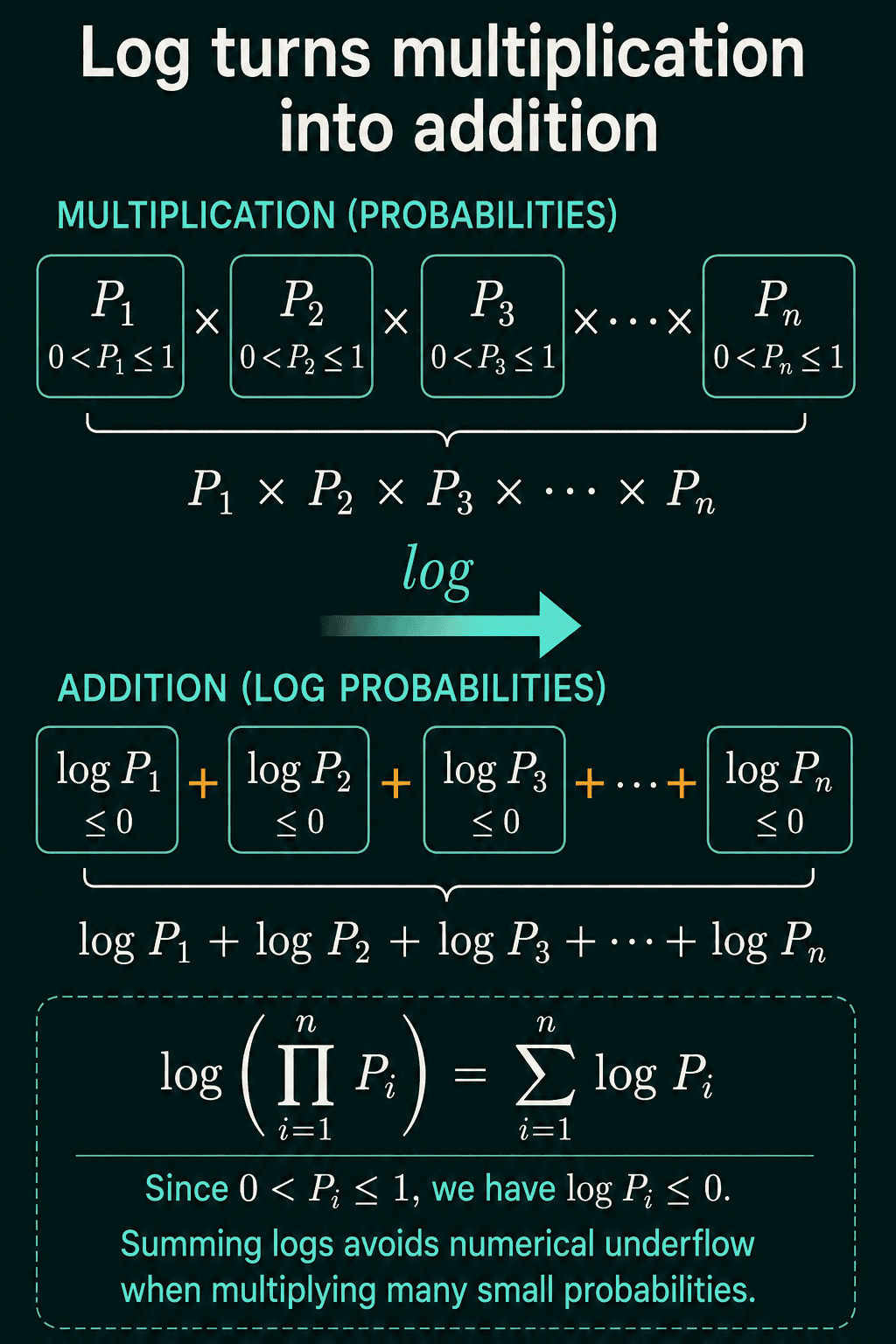
Logarithms show up in most machine learning loss functions because a log turns a product into a sum. This post covers the exponent and log rules, what an inverse function is, and why training works with log-likelihood instead of multiplying probabilities, with PyTorch code.
Math toolkit and notation
Exponents and logarithms for machine learning
Logarithms show up in most machine learning loss functions because a log turns a product into a sum. This post covers the exponent and log rules, what an inverse function is, and why training works with log-likelihood instead of multiplying probabilities, with PyTorch code.
 Math toolkit and notation
Sine and cosine for machine learning
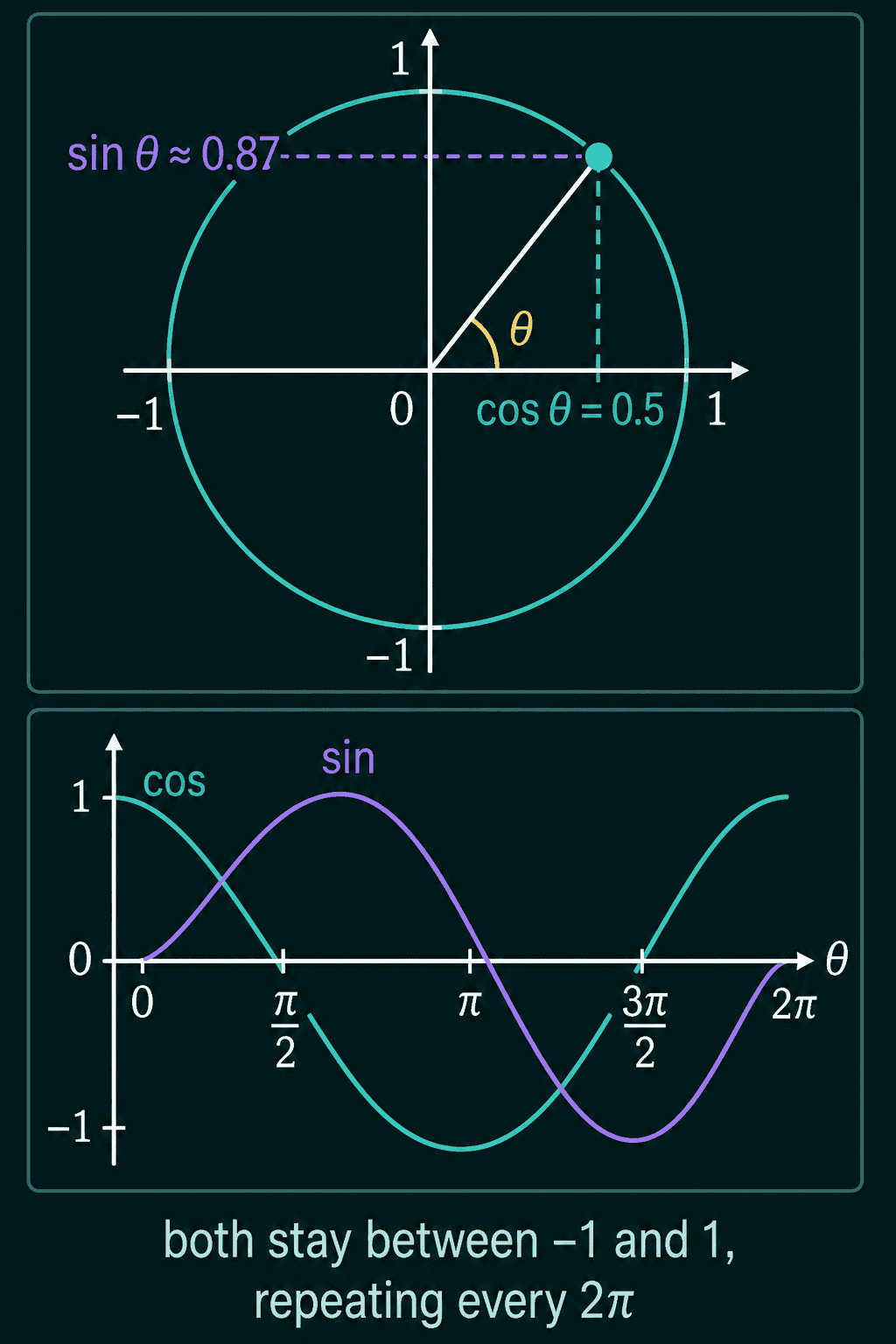
Sine and cosine are the coordinates of a point on a circle of radius 1, and they repeat every full turn. This post explains the unit circle, the identity sin² + cos² = 1, and how sine and cosine features let a model see that hour 23 and hour 0 are one hour apart, with PyTorch code.
Math toolkit and notation
Sine and cosine for machine learning
Sine and cosine are the coordinates of a point on a circle of radius 1, and they repeat every full turn. This post explains the unit circle, the identity sin² + cos² = 1, and how sine and cosine features let a model see that hour 23 and hour 0 are one hour apart, with PyTorch code.