By Sagi Shaier · 11 October 2026 · 6 min read
Derivatives for machine learning: limits, continuity, and the derivative
How the derivative is built from a limit, when a function has no derivative at a point (and why ReLU has a kink at 0), the seven rules that cover most expressions, and how to get the sigmoid's derivative in one line, with Python to check each result.
A derivative is the slope of a function at a single point: how fast the output changes when the input moves a tiny amount. Training a neural network runs on derivatives, because the model changes each weight in the direction that makes the loss go down, and the derivative of the loss with respect to that weight is what gives the direction.
What a limit is
The slope between two points is easy to compute. The slope at one point needs a way to talk about "getting closer and closer" without ever arriving, and that is what a limit does.
A limit asks what value $f(x)$ approaches as $x$ gets closer and closer to some value $a$. It does not ask what happens exactly at $a$, only what the function is heading toward as $x$ comes in from both sides. With $L$ for the value approached, it is written
$$\lim_{x \to a} f(x) = L$$
and read as "as $x$ approaches $a$, $f(x)$ approaches $L$."
Take $f(x) = \frac{x^2 - 4}{x - 2}$ near $x = 2$. Putting $x = 2$ in directly gives $\frac{0}{0}$, which is not a number, so the function has no value at 2. The numerator factors as $x^2 - 4 = (x - 2)(x + 2)$, and for every $x \neq 2$ the two $(x - 2)$ factors cancel, leaving $x + 2$. As $x$ approaches 2, $x + 2$ approaches 4:
$$\lim_{x \to 2} \frac{x^2 - 4}{x - 2} = 4$$
Evaluating the function on both sides of 2 shows the same thing:
1def f(x):
2    return (x**2 - 4) / (x - 2)
3
4for x in [1.9, 1.99, 1.999, 2.001, 2.01, 2.1]:
5 print(x, round(f(x), 6))11.9 3.9
21.99 3.99
31.999 3.999
42.001 4.001
52.01 4.01
62.1 4.1The function approaches 4 from both sides and has no value at 2 itself. That $\frac{0}{0}$ shape is the one that shows up inside the definition of the derivative.
One-sided limits
"From both sides" can fail. The left-hand limit $\lim_{x \to a^-} f(x)$ is what $f$ approaches as $x$ comes up from below $a$. The right-hand limit $\lim_{x \to a^+} f(x)$ is what it approaches coming down from above. The two-sided limit exists when both one-sided limits exist and are equal. A step function that jumps from 0 to 1 at $a$ has a left-hand limit of 0 and a right-hand limit of 1, so it has no two-sided limit at $a$.
Continuity
A function is continuous at $a$ if its graph passes through that point with no jump, hole, or break. In terms of limits, $f$ is continuous at $a$ when
$$\lim_{x \to a} f(x) = f(a)$$
which says the value the function approaches is the value it takes there.
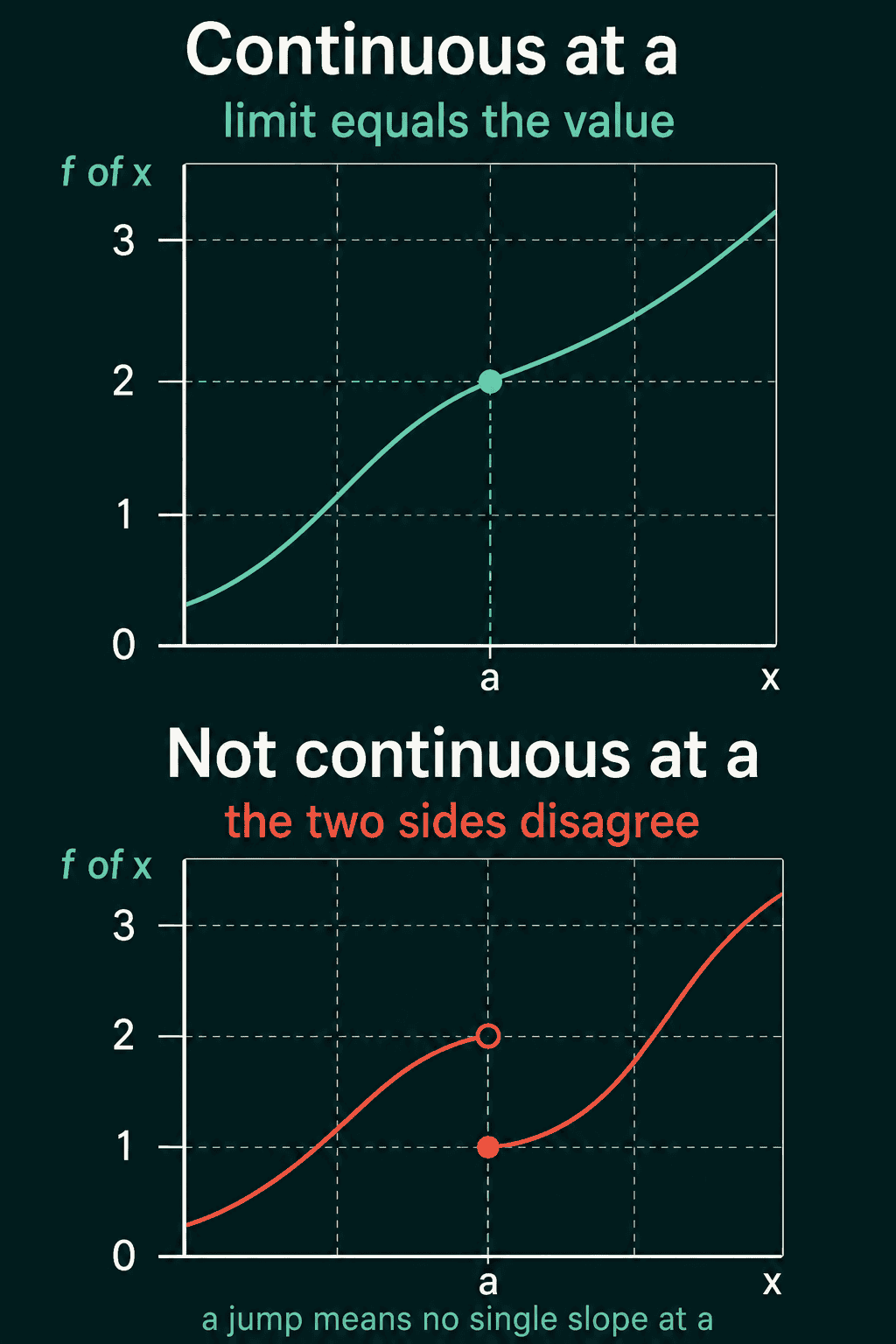
A slope at a point needs continuity there, since a function that jumps at $a$ has no single slope at the jump. Continuity is not enough on its own, though. $f(x) = |x|$ is continuous everywhere, and at $x = 0$ its slope is $-1$ coming from the left and $+1$ coming from the right, so it has no single slope at 0. A function with no derivative at a point is called not differentiable there.
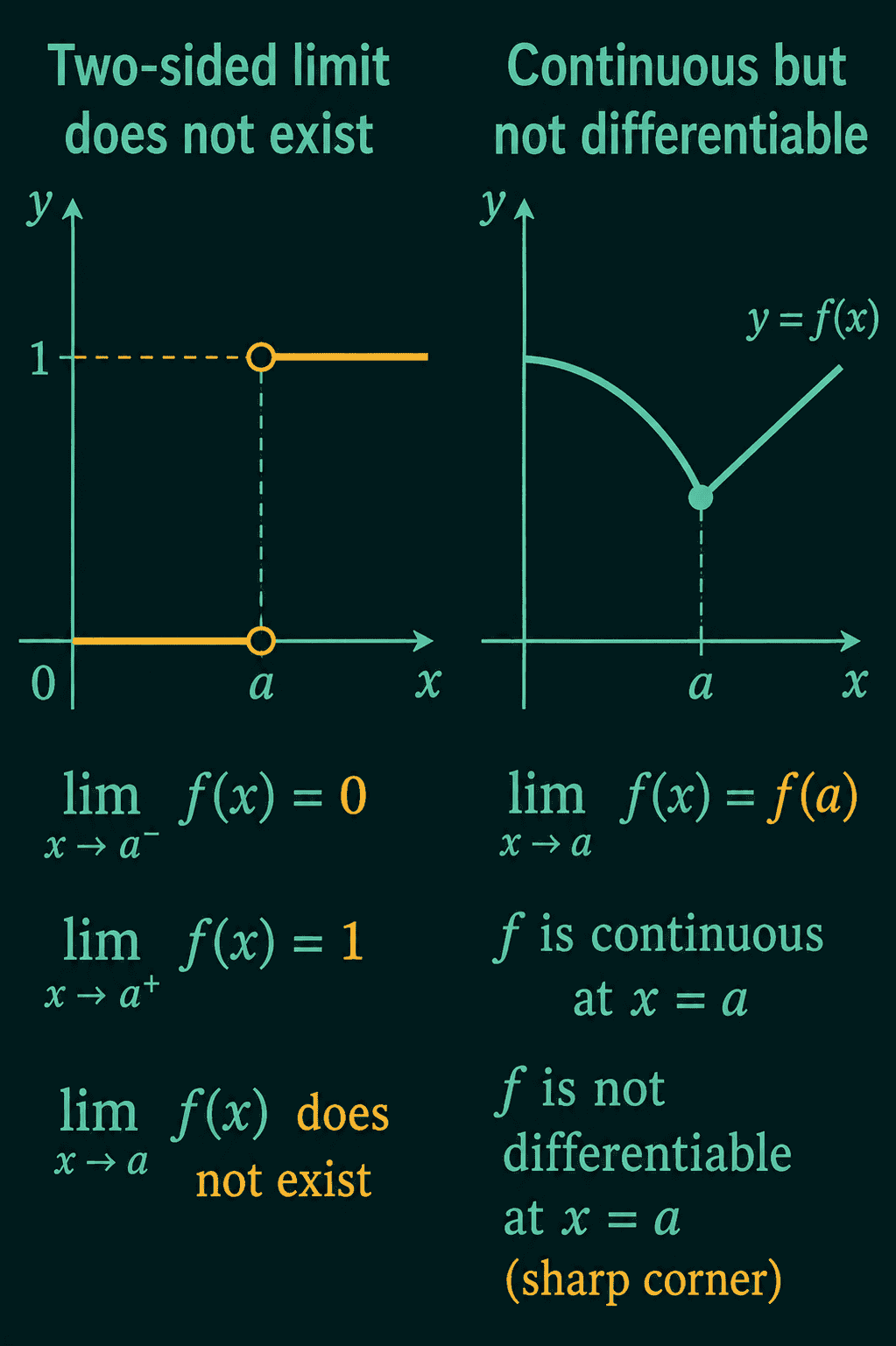
This shows up in neural networks. ReLU, a common activation function, is $\text{ReLU}(x) = \max(0, x)$: 0 for negative inputs and $x$ for positive ones. It has the same kind of corner at 0, with slope 0 on the left and 1 on the right.
The derivative as a limit
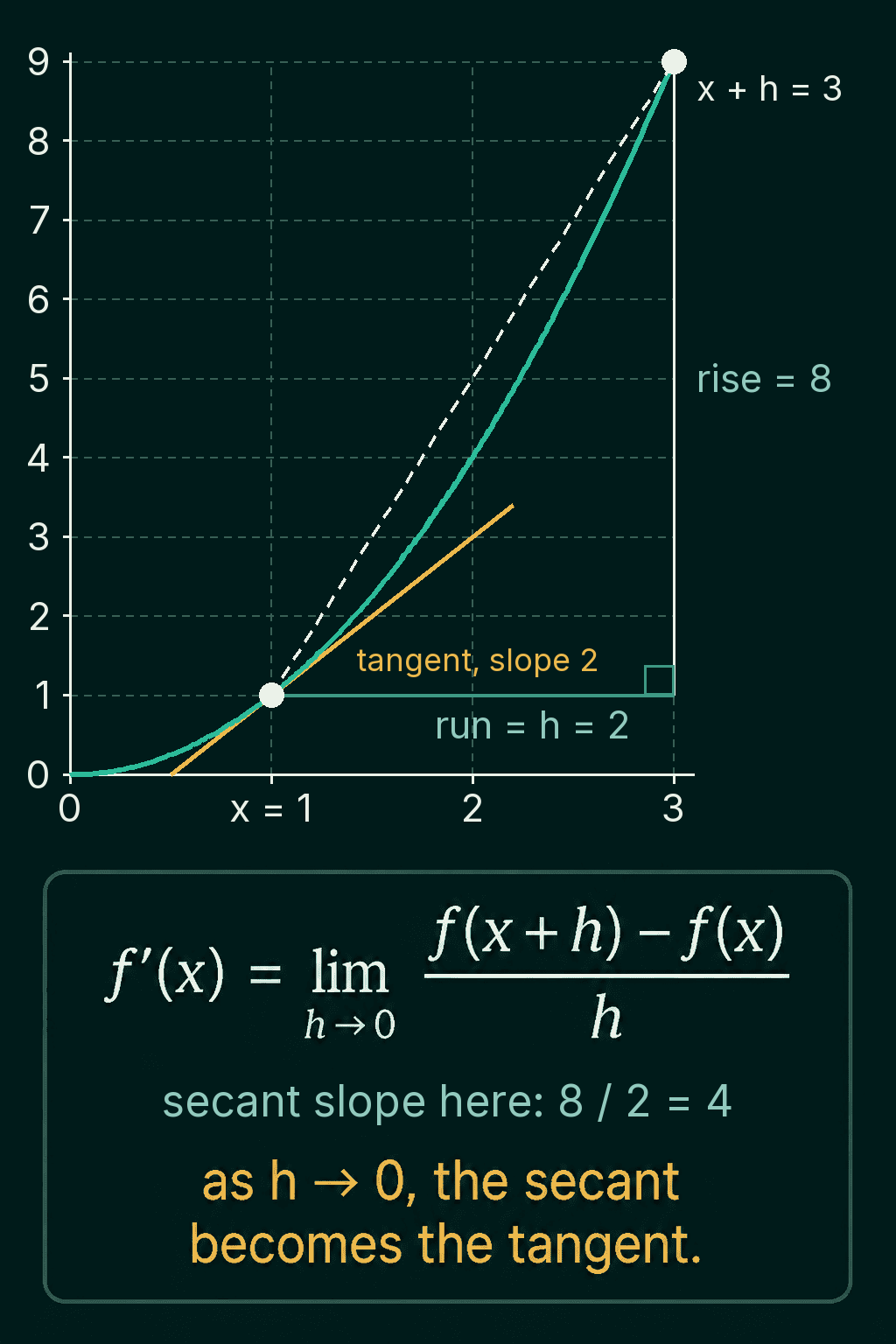
Pick a point $x$ and a second point a distance $h$ away, at $x + h$. The slope of the straight line through the two points on the curve, called a secant line, is rise over run:
$$\frac{f(x+h) - f(x)}{h}$$
As $h$ shrinks toward 0, the second point slides toward the first. The secant line then turns into the tangent line, which matches the curve's direction at $x$. The slope of the tangent line is the derivative:
$$f'(x) = \lim_{h \to 0} \frac{f(x+h) - f(x)}{h}$$
It is also written $\frac{df}{dx}$, and the two notations mean the same thing.
For $f(x) = x^2$ at $x = 1$ with $h = 2$, the two points are $(1, 1)$ and $(3, 9)$, so the secant slope is $\frac{8}{2} = 4$. Shrinking $h$ moves that slope toward the derivative:
1def f(x):
2    return x**2
3
4x = 1.0
5for h in [2, 1, 0.1, 0.01, 0.001]:
6    slope = (f(x + h) - f(x)) / h
7 print(h, round(slope, 6))12 4.0
21 3.0
30.1 2.1
40.01 2.01
50.001 2.001The secant slope heads to 2, so the derivative of $x^2$ at $x = 1$ is 2.
The rules for computing derivatives
Taking the limit by hand every time is slow, and a few rules cover most expressions. Here $c$ is a constant and $n$ is a number.
- Power rule: $\frac{d}{dx} x^n = n x^{n-1}$. So $\frac{d}{dx} x^2 = 2x$, which is 2 at $x = 1$, matching the table above.
- Constant multiple: $\frac{d}{dx} [c \cdot f(x)] = c \cdot f'(x)$. A constant factor stays in front.
- Sum rule: $\frac{d}{dx} [f(x) + g(x)] = f'(x) + g'(x)$. Each term is differentiated on its own.
- Product rule: $\frac{d}{dx} [f(x) g(x)] = f'(x) g(x) + f(x) g'(x)$. For example, $\frac{d}{dx}(x^2 \cdot x^3) = 2x \cdot x^3 + x^2 \cdot 3x^2 = 5x^4$, which is what the power rule gives for $x^5$.
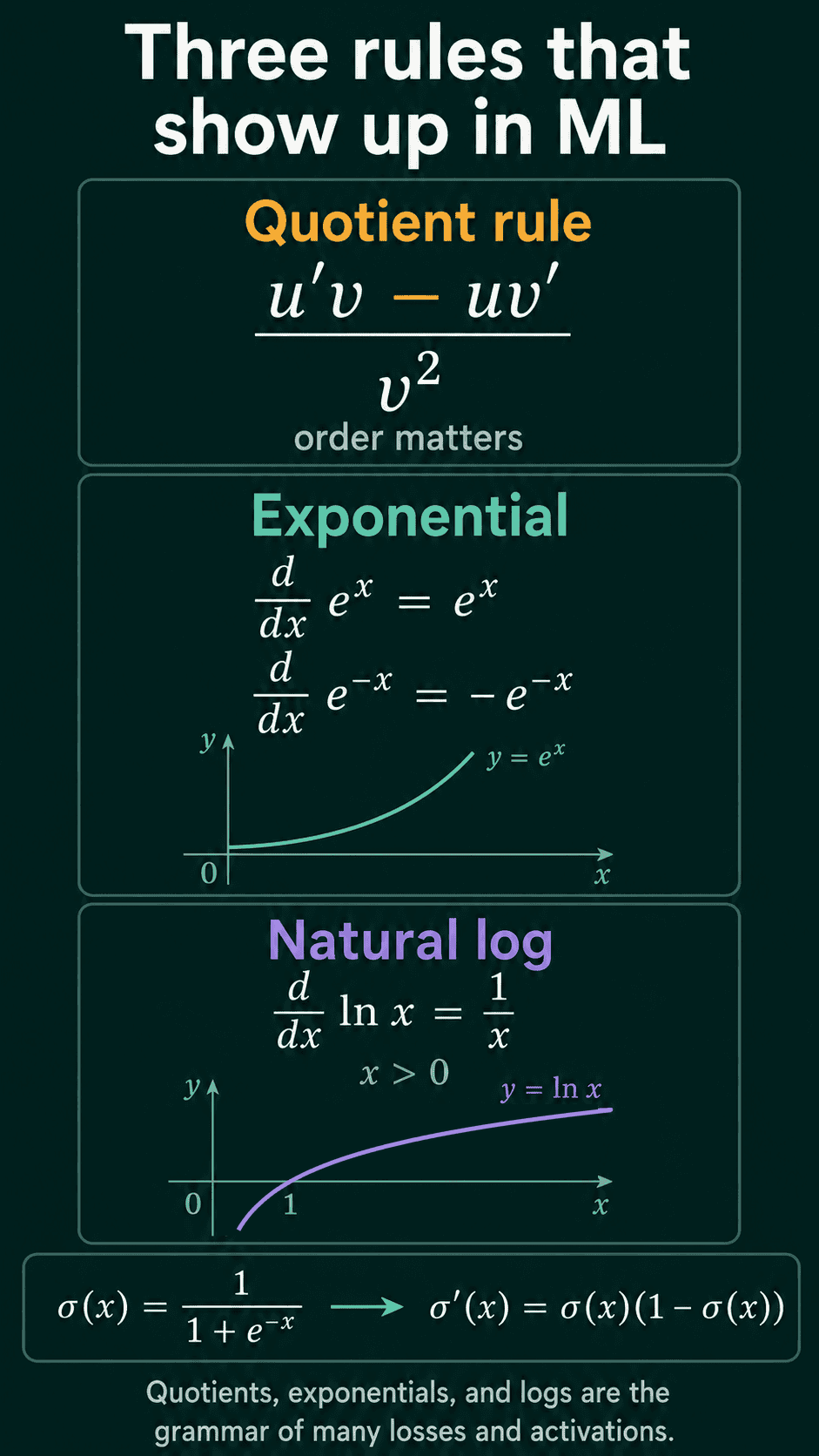
Those four handle polynomials. Losses and activation functions in machine learning also use the exponential $e^x$ and the natural logarithm $\ln x$, and divisions of one expression by another, which take three more rules:
- Quotient rule: $\frac{d}{dx}\left[\frac{u(x)}{v(x)}\right] = \frac{u'(x) v(x) - u(x) v'(x)}{v(x)^2}$. The numerator is the derivative of the top times the bottom, minus the top times the derivative of the bottom, and swapping the two terms flips the sign of the answer.
- Exponential: $\frac{d}{dx} e^x = e^x$, so the exponential is its own derivative. With a minus sign inside, $\frac{d}{dx} e^{-x} = -e^{-x}$.
- Natural log: $\frac{d}{dx} \ln x = \frac{1}{x}$, for $x > 0$. Cross-entropy losses are built from logs, which is why their derivatives come out short.
Worked example: the derivative of the sigmoid
The sigmoid function squashes any number into the range 0 to 1, and it is used as an activation function and to turn a score into a probability:
$$\sigma(x) = \frac{1}{1 + e^{-x}}$$
It is a quotient, with $u = 1$ on top and $v = 1 + e^{-x}$ underneath. The derivative of the constant 1 is $u' = 0$, and the exponential rule gives $v' = -e^{-x}$. The quotient rule then gives
$$\sigma'(x) = \frac{0 \cdot (1 + e^{-x}) - 1 \cdot (-e^{-x})}{(1 + e^{-x})^2} = \frac{e^{-x}}{(1 + e^{-x})^2}$$
Splitting the fraction into two factors shows more:
$$\frac{e^{-x}}{(1 + e^{-x})^2} = \frac{1}{1 + e^{-x}} \cdot \frac{e^{-x}}{1 + e^{-x}}$$
The first factor is $\sigma(x)$. The second is $1 - \sigma(x)$, because $1 - \frac{1}{1 + e^{-x}} = \frac{e^{-x}}{1 + e^{-x}}$. So
$$\sigma'(x) = \sigma(x)\big(1 - \sigma(x)\big)$$
The derivative uses only the sigmoid's own output. A network that already computed $\sigma(x)$ on the way forward gets the derivative with one subtraction and one multiplication, without evaluating the exponential again.
A secant slope with a very small $h$ checks the result numerically:
1import math
2
3def sigmoid(x):
4    return 1 / (1 + math.exp(-x))
5
6x, h = 0.5, 1e-6
7numeric = (sigmoid(x + h) - sigmoid(x)) / h
8formula = sigmoid(x) * (1 - sigmoid(x))
9print(round(numeric, 6), round(formula, 6))10.235004 0.235004Common mistakes
- Plugging in and stopping at $\frac{0}{0}$. It means the expression has no value at that point, not that the limit is undefined. Simplify first, as with $\frac{x^2 - 4}{x - 2}$.
- Treating continuous as differentiable. $|x|$ and ReLU are continuous at 0 and still have no single slope there.
- Swapping the quotient rule's numerator. $u'v - uv'$ is correct, and $uv' - u'v$ gives the negative of the answer.
- Using $\frac{1}{x}$ for $\ln x$ at $x \le 0$. The natural log is only defined for positive inputs.
- Checking a derivative with a large $h$. With $h = 2$, the secant slope of $x^2$ at 1 is 4, double the derivative. A numeric check needs a small $h$, such as $10^{-6}$.
Related math
The derivative here takes one input. Functions of many inputs, such as a loss that depends on every weight in a network, use partial derivatives and gradients. The exponential and log functions themselves are in exponents and logarithms for machine learning.
QuiddityML teaches limits and derivatives as the first concepts of the calculus part of the Math track, with exercises that find the sigmoid's derivative and spot the bug in a polynomial derivative function. The last one is writing derivative_of_polynomial from scratch.